

News
18
Aug
How Disorganized Tool Storage Is Quietly Costing Your Repair Shop Money
Introduction: The Cost You're Not Tracking
Ask a shop owner what's eating into their margins, and they'll usually point to parts costs, labor rates, or slow-paying customers. Almost nobody points to tool storage — because the cost of disorganized tools doesn't show up as a line item on any invoice. It shows up as a few extra minutes here, a damaged tool there, a technician walking across the shop for the third time in an hour. None of it looks dramatic in isolation. Added up over a month, it's a real drain on productivity that a better tool storage system directly addresses.
The Hidden Cost #1: Technicians Searching Instead of Working
Every minute a technician spends looking for a tool — checking a coworker's bench, digging through an unorganized drawer, walking to another bay — is a minute they're not billing, not turning a vehicle around, and not moving to the next job.
A shop with even a modest amount of daily "searching time" per technician loses meaningful billable hours over a full month, multiplied across every tech on the floor
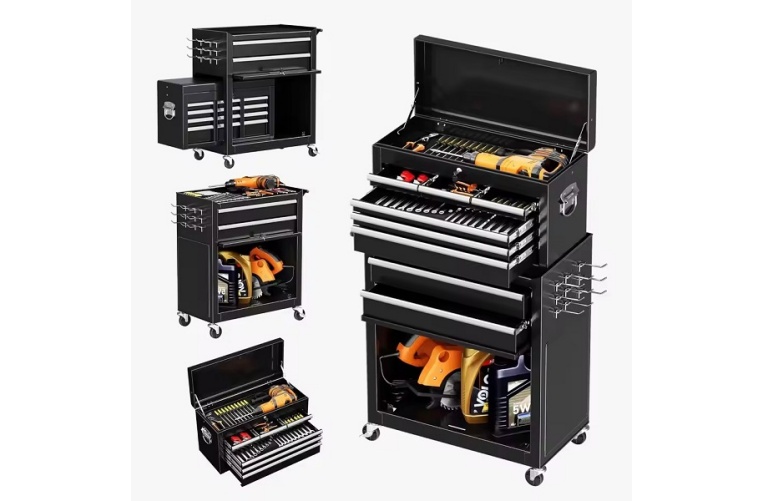
Customizable drawer configurations, set up specifically for wrenches, diagnostic tools, or pneumatic equipment, eliminate the guesswork of "which drawer did that go in" that slows down even experienced technicians in a disorganized shop
Deep drawers, open shelves, and side hooks organized by tool type mean a technician can find what they need without pausing their workflow to ask around
The Hidden Cost #2: Tools Damaged by Poor Storage
Tools tossed into an unlined drawer, exposed to grease and debris, or stacked haphazardly wear out faster and perform worse — and replacing damaged tools is a cost that compounds over time.
Oil-resistant, anti-slip drawer liners protect tools from sliding around during use and from sitting directly in accumulated grease and debris, extending the working life of everything stored inside
Removable liners mean cleaning is quick rather than a reason to put off maintenance — a shop that avoids cleaning drawers because it's a hassle ends up with tools sitting in buildup for weeks at a time
A reinforced, thickened steel frame protects heavier equipment from the kind of structural stress that cheaper, thinner cabinets can't handle over years of daily use
The Hidden Cost #3: Immobile Storage in a Shop That Needs to Move
Fixed tool storage assumes your shop layout never changes and your work never leaves the building. Neither assumption holds up in most real operations.
Shops that reorganize bays, add lifts, or shift workflow around new equipment often find a single oversized, immovable cabinet becomes an obstacle rather than a help
Mobile and fleet repair operations lose real time and flexibility when tools are stuck in a fixed location instead of being loadable directly onto a service vehicle
A detachable, modular cabinet system solves this directly — units can be split apart to spread across multiple bays, recombined into a single station, or loaded onto a truck for off-site and roadside repair work, without ever needing to replace the storage system itself
The Hidden Cost #4: Security Gaps That Lead to Theft or Loss
Tool theft and unauthorized borrowing are more common in shared shop environments than most owners like to admit, and the cost isn't just the tool itself — it's the downtime waiting for a replacement.
An anti-pry key lock protects higher-value tools and diagnostic equipment from opportunistic theft, which matters especially in shops with rotating staff, contractors, or after-hours access
Centralizing higher-value tools in a single, lockable, well-organized system also makes it easier to notice quickly when something is actually missing, instead of only discovering it mid-job
The Hidden Cost #5: Workflow Interruptions From Poor Layout
A tool cabinet that doesn't match how your shop actually works creates small interruptions throughout the day that add up to a real productivity gap.
An integrated work surface on top of the cabinet gives technicians a place to set tools during an inspection or small assembly task without walking to a separate bench — a small design detail that removes dozens of tiny interruptions per week
External accessory mounts for hooks, hose organizers, and tool holders keep frequently used items within arm's reach instead of buried in a drawer, cutting down on the small but constant motion of digging for something that should already be visible
What Fixing This Actually Looks Like
None of these costs require a major operational overhaul to solve — they mostly come down to choosing a tool storage system actually built for how a working shop operates:
Organize by task, not by whatever fits — customizable drawer layouts matched to your actual tool inventory
Protect what you store — oil-resistant liners and reinforced steel construction that hold up to daily wear
Make storage move with the work — modular, detachable units for shops that reconfigure layouts or handle mobile repair jobs
Lock down what matters — anti-pry security for higher-value tools and equipment
Design around the technician's actual motion — integrated work surfaces and accessory mounts that reduce unnecessary walking and searching
Frequently Asked Questions
How much time does poor tool organization actually cost a shop?
It varies by shop size and volume, but even a few minutes of searching time per technician per day adds up to meaningful lost billable hours across a month — time that a well-organized, easily navigable tool storage system largely eliminates.
Does tool cabinet quality really affect how long tools last?
Yes. Tools stored without proper liners or protection from grease and debris wear out and corrode faster, while a poorly built cabinet frame can itself become damaged under the weight of a full tool inventory, both of which add avoidable replacement costs over time.
Is a modular tool cabinet worth it for a shop that doesn't move locations often?
Even shops that stay in one place benefit from modularity when bay layouts change, new equipment is added, or the shop simply grows — a fixed, non-adjustable cabinet often becomes a constraint well before the shop is ready to replace its entire storage system.
What's the biggest sign a shop needs better tool storage?
Frequent searching for tools, visible tool damage from poor storage conditions, or a layout that no longer matches how the shop actually operates are all strong signals that current tool storage is quietly costing more than it appears to.
Conclusion
Disorganized tool storage rarely shows up as an obvious problem — it shows up as slightly slower turnaround, slightly more tool replacement, and a shop floor that never quite runs as smoothly as it should. A properly built, modular tool cabinet addresses all of it at once: faster access, better protection, real mobility, and genuine security, without requiring a shop to rethink its entire operation to get there.
Ready to see what a properly configured tool storage system would save your shop? Contact our team for a setup tailored to your bay layout and tool inventory.
Contact Us
📞 Phone/WhatsApp: +86 132 1355 7186
📧 Email: sales@buysmartlocker.com
Our Contact
Minno Furtniture
Customize smart storage lockers,parcel delivery lockers, key management cabinet,Vending machines,Office/School and home furniture.
-
Call For Inquiry
-
Send Us Email
sales@buysmartlocker.com
Need Help For Project!
We are ready to help your next projects, let’s work together
 WhatsApp
 sales@buysmartlocker.com
 +8613213557186