

News
16
Jul
How Smart Key Management Cabinets Work: A Technical Overview for Security and Facilities Teams
Physical keys remain one of the most common access control tools in the world, and paradoxically, one of the least tracked. A single missing office key, server room key, or vehicle key can sit unnoticed for weeks in organizations still relying on a manual logbook or an unmonitored key box. The smart key management cabinet — also called an electronic key cabinet, intelligent key control system, or RFID key locker — was developed specifically to close that gap, and it's worth understanding how the underlying technology actually functions before evaluating one for a facility, fleet, or security operation.
This article breaks down the core mechanics behind smart key management systems, the security models they support, and where this category of access control equipment is typically deployed.
What Problem Does a Smart Key Cabinet Actually Solve?
Traditional key management usually relies on one of two flawed approaches: a physical logbook that depends entirely on manual entry and honesty, or an unlabeled key cabinet with a single master lock that gives anyone with cabinet access to every key inside it. Neither approach creates a reliable audit trail, and both fail the moment a key goes missing, is used without authorization, or isn't returned on schedule.
A smart key management cabinet replaces this model with individually monitored key slots, multi-factor user authentication, and automatic digital logging — turning key control from a manual, honor-system process into a tracked, permission-based system with a verifiable audit trail for every single withdrawal and return.
Core Technology Behind Smart Key Management Systems
Multi-factor authentication. Rather than a single shared key or code, modern electronic key cabinets typically support RFID card access, fingerprint recognition, facial recognition, PIN code entry, or a combination of these methods. This allows an organization to require two-factor authentication for higher-security key sets, while permitting simpler single-factor access for lower-risk keys.
Sensor-equipped key slots. Each individual key hook or slot inside a smart cabinet is fitted with a sensor that continuously monitors whether a key is present or has been removed. This is the mechanical foundation that makes real-time tracking possible — the system always knows, slot by slot, exactly which keys are currently checked out.
RFID key tagging. Each key is fitted with a unique electronic identifier, commonly an RFID tag, allowing the system to distinguish between individual keys even when several look physically identical. This tagging system is what enables automatic logging of exactly which key was removed, rather than simply detecting that "a key" was taken from a general area.
Centralized management software. A backend software platform allows administrators to configure user permissions, set maximum key loan durations, generate usage reports, and monitor cabinet activity remotely — including across multiple cabinets on a shared network via LAN or WAN connectivity, which matters for organizations managing key control across several buildings or sites from a single administrative point.
Real-time alerts. Automated notifications — via on-cabinet sound and light indicators, SMS, or email — flag events such as unauthorized access attempts, forced entry, overdue key returns, or a key being placed in the wrong slot. This shifts key oversight from a reactive, after-the-fact discovery process to a proactive monitoring system.
Reinforced physical construction. Beneath the electronics, the cabinet itself is typically built from high-strength steel with anti-pry and anti-drill design elements, along with a high-security mechanical override lock reserved for emergency access if the electronic system experiences a fault.
Permission Management: The Feature That Separates Basic and Advanced Systems
One of the more significant differences between a simple electronic lockbox and a genuine smart key management system is granular permission control. Rather than granting blanket cabinet access, administrators can typically define:
Which specific keys or key groups a given user is authorized to access
Maximum authorized loan duration for a specific key
Multi-person authorization requirements for particularly sensitive keys (requiring two or more authorized users to jointly release a critical key)
Time-based access restrictions, limiting when a given user can retrieve certain keys
This level of configurability is what makes smart key cabinets suitable for environments with layered security requirements — a facility where general staff need routine access to common-area keys, but only a limited set of authorized personnel can access server room, vault, or restricted-area keys.
Why Audit Trails Matter More Than They Might Seem
Every interaction with a smart key cabinet — who accessed the system, which key was withdrawn or returned, and the precise timestamp of each action — is logged automatically and stored for administrative review. In practice, this audit trail becomes valuable in ways that go beyond simple key tracking:
Resolving disputes over who last had access to a specific area
Supporting internal investigations following theft, damage, or unauthorized entry
Demonstrating compliance with security protocols during audits or regulatory review
Identifying patterns of misuse, such as a key consistently returned late by the same user
For organizations in regulated industries — finance, healthcare, government, and utilities in particular — this documented chain of custody is often as important as the physical security the cabinet provides.
Common Applications of Smart Key Management Cabinets
Electronic key control systems are deployed across a wide range of industries where physical key volume and security requirements intersect:
Public utilities — managing keys for equipment rooms, valve chambers, and power distribution stations across power, water, and gas infrastructure
Real estate and property management — controlling access to common areas in residential complexes, office towers, and shopping centers
Financial institutions — securing keys for bank branches, vaults, and ATM service rooms
Enterprises and industrial facilities — managing access to data centers, server rooms, laboratories, and warehouses
Automotive dealerships and rental fleets — tracking vehicle key checkout and return across large inventories
Government agencies — controlling access to archives, records rooms, and restricted offices
Educational institutions — managing large volumes of keys for classrooms, laboratories, and administrative offices across schools and universities
Healthcare facilities — securing keys to medication storage, equipment rooms, and restricted clinical areas
Hospitality — supplementing digital access systems by managing back-of-house and staff-only area keys in hotels and apartment complexes
Wall-Mounted vs. Floor-Standing Configurations
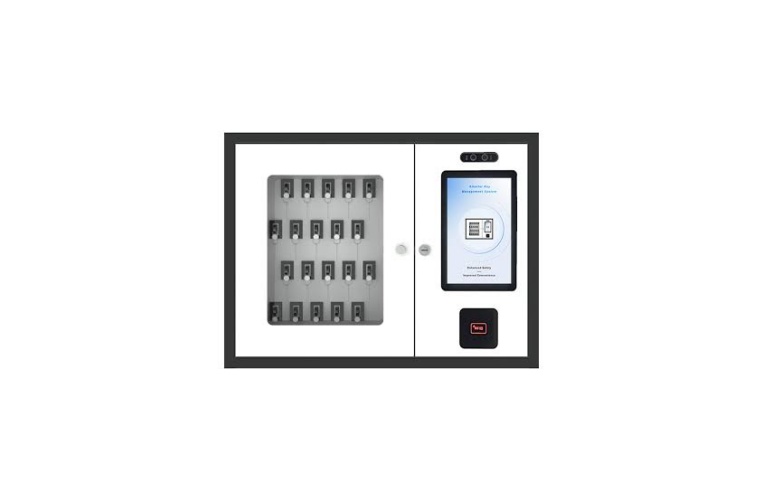
Smart key cabinets are generally available in two structural formats. Wall-mounted units are compact and suited to environments with limited floor space — reception areas, security desks, and smaller equipment rooms — while floor-standing units typically offer higher key slot capacity and are better suited to facilities managing larger key inventories, such as large property management offices or industrial sites. Slot capacity across both formats is generally modular, commonly scaling from around 10 slots up to 100 or more within a single cabinet, allowing an organization to match capacity to actual key inventory rather than over- or under-provisioning.
Evaluating a Smart Key Cabinet: What to Look For
For organizations comparing systems, a few technical factors are generally worth prioritizing over surface-level features:
Authentication flexibility — whether the system supports card, fingerprint, facial recognition, and password access, and whether these can be combined for multi-factor authentication on higher-security key sets
Network capability — whether the cabinet supports WiFi as standard and LAN/WAN connectivity for centralized, multi-site management
Reporting depth — whether the management software generates exportable logs and usage reports suitable for compliance or audit purposes
Physical security rating — construction material, anti-pry/anti-drill design, and the presence of a mechanical override for emergency access
Scalability — whether slot capacity can be adjusted or expanded as an organization's key inventory grows
FAQ
How does a smart key cabinet know which key was removed?
Each key is fitted with a unique electronic tag, commonly RFID-based, and each cabinet slot includes a sensor that detects when a key is present or removed. Together, these allow the system to log exactly which key was taken, by whom, and when.
What authentication methods do smart key cabinets support?
Most systems support RFID card access, fingerprint recognition, facial recognition, and PIN code entry, often in combination for multi-factor authentication on higher-security key sets.
Can access be restricted to specific users for specific keys?
Yes. Administrators can typically assign granular permissions, controlling which keys a given user can access, how long they can hold a key, and whether multi-person authorization is required for particularly sensitive keys.
What happens if a key isn't returned on time?
The system generates a real-time alert — via on-cabinet indicators, SMS, or email — flagging the key as overdue, allowing administrators to follow up immediately rather than discovering the issue later.
Can multiple key cabinets be managed from one location?
Yes, cabinets with LAN/WAN connectivity can typically be centrally managed and monitored from a single administrative platform, which is useful for organizations overseeing key control across multiple buildings or sites.
What happens if the electronic system malfunctions?
Reputable systems include a high-security mechanical override lock, providing emergency physical access to keys in the event of a power failure or electronic fault.
Is a smart key cabinet suitable for a small office, or is it only practical for large facilities?
Both. Slot capacity is generally modular, so a small office might use a compact wall-mounted unit with a limited number of slots, while a large facility might deploy a higher-capacity floor-standing unit — the underlying technology scales to the size of the key inventory being managed.
Organizations evaluating an upgrade from manual key logging to an electronic key management system should start by mapping their current key inventory and access requirements, since slot capacity, authentication method, and network configuration should all be matched to actual operational needs rather than chosen generically.
Contact Us
📞 Phone/WhatsApp: +86 132 1355 7186
📧 Email: sales@buysmartlocker.co
Our Contact
Minno Furtniture
Customize smart storage lockers,parcel delivery lockers, key management cabinet,Vending machines,Office/School and home furniture.
-
Call For Inquiry
-
Send Us Email
sales@buysmartlocker.com
Need Help For Project!
We are ready to help your next projects, let’s work together
 WhatsApp
 sales@buysmartlocker.com
 +8613213557186