

News
17
Aug
How to Choose a Metal Filing Cabinet: A Material, Security, and Design Guide
Introduction: A Filing Cabinet Is a Long-Term Purchase — Treat It Like One
Most offices buy a filing cabinet once and keep it for years, if not decades. That makes it worth evaluating properly rather than picking whatever's cheapest or most immediately available. This guide breaks down the factors that actually determine whether a metal filing cabinet holds up — material, coating, security, interior capacity, and customization — so you know what to check before you buy.
1. Steel Thickness and Construction Quality
Not all "metal" filing cabinets are built to the same standard, and steel gauge is one of the clearest indicators of long-term durability.
Cold-rolled steel is the standard material for quality filing cabinets, offering strong resistance to wear, impact, and corrosion compared to lighter-gauge alternatives
Sheet thickness (commonly specified before painting, typically in the 0.5–1.0mm range for filing cabinets) affects how well the cabinet resists dents and structural stress over years of daily opening and closing
Reinforced corners and frame structure matter more than they might seem — a cabinet that wobbles or flexes when a drawer is opened is a sign of weaker underlying construction, regardless of how solid the exterior looks
Buyer tip: If you're comparing cabinets that look similar in photos, ask directly about steel gauge and frame reinforcement — this is where genuine quality differences hide, and where cheaper cabinets tend to cut corners.
2. Surface Coating and Finish
The finish on a metal filing cabinet isn't just cosmetic — it directly affects corrosion resistance and how the cabinet holds up over time.
Epoxy coating and electrostatic powder coating are standard finishing methods that provide durable, even coverage and meaningfully better corrosion resistance than a simple painted finish
Custom color options, including RAL color matching, allow the cabinet to be finished in a specific shade to match an office's existing furniture or brand identity, rather than settling for whatever's in stock
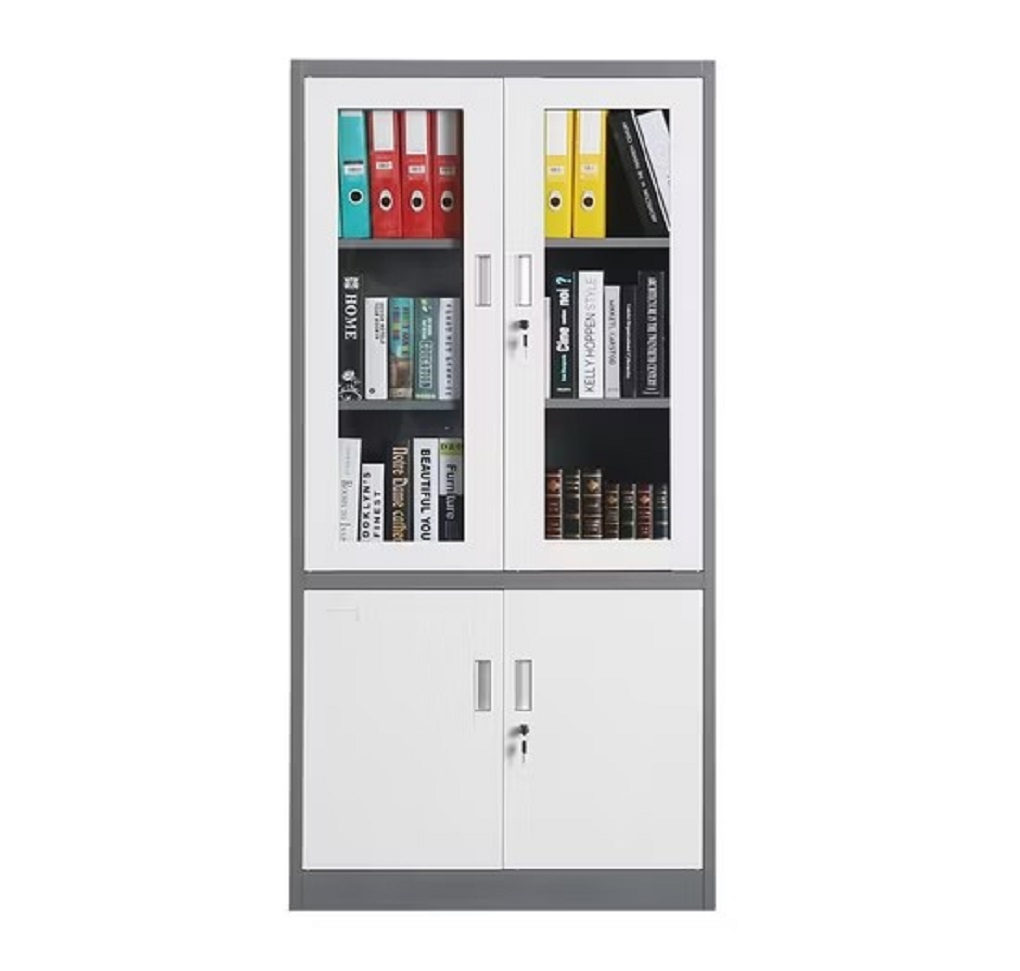
Dual-tone or contrast-color designs have become increasingly popular for offices that want filing storage to look intentional and modern rather than purely utilitarian — proof that "office storage" doesn't have to mean plain gray or beige
3. Locking Mechanisms and Security
Security is often the actual reason a business chooses metal over a cheaper alternative in the first place, so it's worth thinking through carefully.
Lock and handle configuration should typically be customizable to match your specific security needs — some organizations need a simple, single-point lock, while others require different lock types for different departments or document sensitivity levels
Confirm whether the cabinet locks all drawers or compartments at once, or whether each section locks independently, since this affects how you'll manage access across multiple staff members
For healthcare, legal, and financial settings, where document confidentiality carries real compliance weight, a robust, reliable locking mechanism is a non-negotiable feature rather than a nice-to-have
4. Interior Capacity and Organization
A filing cabinet's exterior dimensions only tell part of the story — how the interior is organized determines whether it's actually practical to use day to day.
Adjustable hanging file frames or modular dividers support both letter and A4-size documents, giving flexibility for offices that handle mixed document formats or international paperwork
Drawer or door configuration should match your actual filing volume and access patterns — a single large compartment works differently in practice than several smaller, individually organized sections
Stackable or freestanding options offer flexibility for offices that may need to scale storage capacity later without replacing the entire system
5. Dimensions and Space Planning
Before ordering, confirm the cabinet's full dimensions against your actual available space — height, width, and depth all matter, especially in smaller offices or home office setups.
Standard filing cabinets are commonly available in configurations suited to typical office footprints, but always confirm exact height, width, and depth against your floor plan before committing
Consider drawer clearance as well as the cabinet's footprint — a cabinet that fits against a wall on paper may still need more clearance than expected once drawers are fully extended
6. Customization Options Worth Asking About
A capable manufacturer should be able to offer more than a fixed catalog model. Before you order, ask specifically about:
Color customization, including RAL color matching for brand consistency across an office or multiple locations
Lock and handle options, tailored to your specific security requirements
Dimension adjustments, for organizations with non-standard space constraints
Structure type — knocked-down (flat-pack) construction is common for filing cabinets and can simplify shipping and on-site assembly compared to fully pre-assembled units
7. What to Confirm Before You Order
Shipping and delivery timeline — confirm production and shipping lead time in writing, particularly for larger or multi-unit office orders
Packaging quality — for international orders, ask how the cabinet is packaged (multilayer carton, protective padding) to ensure it arrives undamaged after freight transit
Payment and order terms — clarify deposit requirements and payment milestones before finalizing an order, especially for bulk or custom-configured orders
Feature Checklist Before You Buy
| Category | What to Confirm |
|---|---|
| Material | Steel type (cold-rolled), sheet thickness before painting |
| Finish | Coating type (epoxy/powder), available custom colors |
| Security | Lock type, independent vs. unified drawer locking |
| Interior | Hanging file support, letter/A4 compatibility, divider options |
| Dimensions | Height, width, depth against your actual floor space |
| Customization | Color, lock/handle type, structure (knocked-down vs. assembled) |
| Logistics | Lead time, shipping port, packaging method |
Frequently Asked Questions
What's the difference between a cheap metal filing cabinet and a higher-quality one?
The differences usually come down to steel gauge, coating quality, and lock reliability. Thinner steel dents and warps faster, lower-quality coating corrodes sooner, and basic locks are easier to bypass — all factors that don't show up in a product photo but matter significantly over years of use.
Can I get a filing cabinet in a specific color to match my office?
Many manufacturers support RAL color matching and custom finishes, including dual-tone or contrast-color designs, allowing the cabinet to align with an office's existing decor or brand identity rather than defaulting to standard gray or beige.
Do all filing cabinet drawers lock individually, or is there one lock for the whole unit?
This varies by model and manufacturer. Some cabinets use a single lock that secures all drawers or compartments at once, while others allow independent locking per section — confirm which configuration you need based on how many people need varying levels of access.
How long does it typically take to receive a custom filing cabinet order?
Lead times vary by manufacturer and order size, but it's common for custom-configured orders to ship within a few weeks of payment confirmation. Always request a specific delivery timeline in writing before finalizing your order.
Conclusion
A metal filing cabinet is one of those purchases that's easy to underthink — until a drawer jams, the lock fails, or the finish starts corroding a year in. Steel quality, coating, locking mechanism, and interior organization are the factors that actually determine whether a cabinet holds up for the long haul, and a reputable manufacturer should be able to speak to all of them clearly before you order.
Need a filing cabinet configured for your office's exact size, color, and security requirements? Contact our team for a custom specification and quote.
Contact Us
📞 Phone/WhatsApp: +86 132 1355 7186
📧 Email: sales@buysmartlocker.com
Our Contact
Minno Furtniture
Customize smart storage lockers,parcel delivery lockers, key management cabinet,Vending machines,Office/School and home furniture.
-
Call For Inquiry
-
Send Us Email
sales@buysmartlocker.com
Need Help For Project!
We are ready to help your next projects, let’s work together
 WhatsApp
 sales@buysmartlocker.com
 +8613213557186