

News
06
Aug
Inside the Engineering of the MINNO Mobile Shelving System: Structure, Safety, and Customization Explained
For architects, structural engineers, and facility planners, a mobile shelving system isn't just furniture — it's a load-bearing, mechanically operated system that has to perform reliably under sustained weight, daily use, and years of operation without failure. This article breaks down the actual engineering behind the MINNO Mobile Shelving System: its structural specifications, movement mechanisms, safety systems, and customization options, so technical decision-makers can evaluate it against project requirements.
Structural Design and Materials
The MINNO Mobile Shelving System is built from reinforced steel, using panel and frame thicknesses ranging from 0.8mm to 1.2mm, depending on the component and load requirements. This range reflects a deliberate engineering choice: thicker gauge steel is used in structural load-bearing elements, while lighter gauge steel is used in non-structural panels to control overall system weight without compromising strength where it matters.
Core dimensional specifications:
| Parameter | Specification |
|---|---|
| Overall dimensions (H x W x L) | 2300mm x 560mm x 900mm |
| Material | Metal (steel) |
| Thickness range | 0.8mm–1.2mm |
| Structure type | Knocked-down (KD) |
| Single package size | 91 x 56 x 60cm |
| Single unit gross weight | 130.5kg |
| Surface finish | Environmental protection powder coating |
| Certifications | ISO9001 (quality management), ISO14001 (environmental management) |
The knocked-down (KD) structure is a deliberate design decision with real engineering and logistics implications. Rather than shipping pre-assembled units — which are bulky, expensive to freight, and prone to transit damage — the system ships in flat, compact packaging and is assembled on-site. This reduces shipping volume significantly compared to pre-assembled shelving, lowers freight costs, and reduces the risk of structural damage during transport, while still allowing for a rigid, fully braced final structure once assembled correctly on-site.
How the Mobile Carriage and Rail System Works
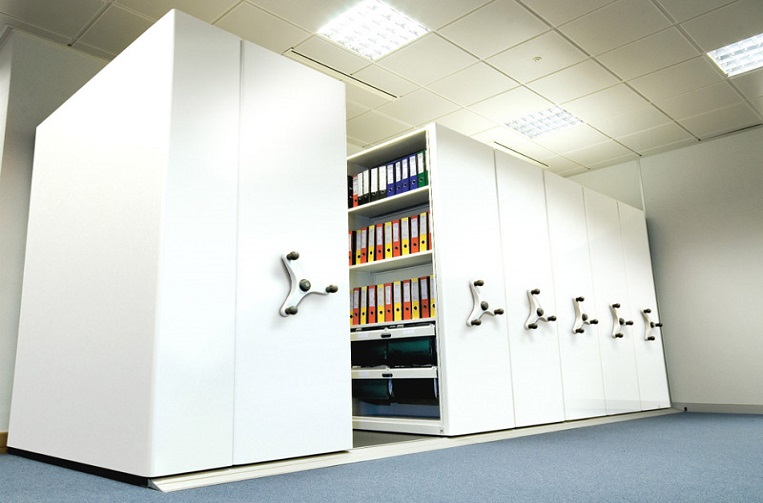
The defining engineering feature of any mobile shelving system is the carriage-and-rail mechanism that allows entire rows of shelving to move laterally along the floor. This system consists of three core components:
Floor-mounted rails — precision-aligned tracks embedded in or mounted to the floor, which bear the full distributed weight of the loaded shelving as it moves.
Carriages — the wheeled base units beneath each shelving row, engineered to distribute the load evenly across the rail system and roll smoothly under full load without binding or excessive friction.
Drive mechanism — the method by which carriages are moved, which in the MINNO system can be specified as manual, electric, or smart.
Manual Adjustment
Manual systems use an ergonomically designed handwheel connected to a gear-driven mechanism, allowing a single operator to move a fully loaded row of shelving with relatively low physical effort, even at significant total load weight. This is typically the most cost-effective and lowest-maintenance option, well suited to lower-traffic archive rooms.
Electric Adjustment
Electric systems replace manual hand-cranking with a motorized drive, activated by a control switch, button panel, or similar interface. This significantly reduces the physical effort required to open an aisle and is generally preferred in high-traffic environments, or where accessibility requirements make manual operation impractical for some staff.
Smart Adjustment
The smart configuration adds an electronic control layer on top of motorized movement — which can include touchscreen control panels, RFID-based authorization (restricting who can open specific rows), or remote-controlled aisle opening. This tier is generally specified for facilities with higher security requirements or that want centralized management of access logs and usage data.
Safety Engineering
Because a mobile shelving system involves large, heavy structures physically moving along a rail system, safety engineering is not optional — it's a core design requirement. The MINNO system incorporates several layered safety mechanisms:
Anti-tilt protection. Structural bracing and carriage design are engineered to prevent shelving units from tipping, even when fully loaded and in motion, which is critical given that a fully loaded row can weigh well over 100kg per unit before accounting for stored materials.
Obstruction/safety sensors. Sensor-equipped configurations are designed to detect an obstruction (including a person) in the aisle path and halt carriage movement automatically, preventing the shelving from closing on anyone standing between rows during operation.
Centralized locking. Beyond physical safety, the locking system serves a security engineering function — securing an entire row or section with a single mechanism rather than requiring individual shelf-level locks, which reduces both point-of-failure risk and the administrative burden of managing multiple lock points.
Load-Bearing and Capacity Considerations
Load capacity in a mobile shelving system depends on the interaction of several engineering factors: steel gauge and frame design, carriage and rail load rating, and shelf span (the horizontal distance a shelf must support without sagging). MINNO's reinforced steel frame and panel construction is specifically designed to maintain load-bearing performance under full, sustained weight — a requirement given that archive and library shelving is often loaded to capacity and left that way for years without redistribution.
For technical planners, it's worth noting that the structural load path in a mobile shelving system runs from the stored materials, through the shelf, into the frame, down through the carriage, and finally into the floor-mounted rail — meaning floor loading capacity at the installation site should always be evaluated alongside the shelving unit's own rated capacity, particularly for upper-floor installations in multi-story buildings.
Environmental and Material Considerations
The environmental protection powder coating used on the MINNO system serves both an aesthetic and a functional engineering purpose: it provides corrosion resistance and durability against the wear associated with constant carriage movement and daily handling, extending the operational lifespan of the structure compared to unfinished or lower-grade coatings.
For facilities storing sensitive archival materials — rare documents, film, or historically significant records — the system can also be configured with additional dust-proof or humidity-resistant features, which matters for long-term preservation in environments where climate control may be inconsistent.
Customization and Manufacturing
As a manufacturer, MINNO offers end-to-end customization across four core dimensions:
Structural design — dimensions, shelf configuration, and layout adapted to the specific room and collection type
Load capacity — frame and panel specification adjusted to the expected weight of stored materials
Operating system — manual, electric, or smart adjustment, selected based on traffic volume and accessibility needs
Smart features — touchscreen control, RFID authorization, and remote-controlled operation, where higher-security or higher-traffic requirements apply
This level of customization is possible because MINNO manufactures the system directly (Luoyang, Henan, China), under ISO9001 and ISO14001 certification, rather than distributing a fixed, off-the-shelf catalog product.
Technical Summary Table
| Engineering Category | MINNO Specification |
|---|---|
| Frame material | Reinforced steel, 0.8–1.2mm thickness |
| Structure type | Knocked-down, on-site assembly |
| Movement mechanism | Manual handwheel / electric motor / smart control |
| Safety systems | Anti-tilt protection, obstruction sensors, centralized locking |
| Surface treatment | Environmental protection powder coating |
| Certification | ISO9001, ISO14001 |
| Customization scope | Structure, load capacity, operating system, smart features |
Frequently Asked Questions
What steel thickness does the MINNO Mobile Shelving System use?
Panel and frame components range from 0.8mm to 1.2mm, with thicker gauge steel used in structural load-bearing elements.
What's the difference between manual, electric, and smart mobile shelving systems from an engineering standpoint?
Manual systems use a mechanical handwheel and gear drive; electric systems replace this with a motorized drive activated by a control switch; smart systems add an electronic control layer, such as a touchscreen or RFID-based authorization, on top of motorized movement.
How does a knocked-down structure affect installation?
A knocked-down (KD) structure ships disassembled in compact packaging, reducing freight costs and transit damage risk, and is assembled on-site into a fully braced, rigid structure.
What safety mechanisms prevent accidents during shelving movement?
Anti-tilt protection and obstruction/safety sensors are engineered into the system to prevent tipping and to halt carriage movement automatically if an obstruction is detected in the aisle.
Can the load capacity be customized for heavier storage needs?
Yes. Because MINNO manufactures the system directly, frame and panel specifications can be adjusted based on the expected weight of stored materials for a given project.
Specify a Mobile Shelving System Built to Your Project's Load and Safety Requirements
For architects, engineers, and facility planners working on archive, library, or records storage projects, MINNO provides direct manufacturer support for structural specification, load capacity planning, and safety system selection — under ISO9001 and ISO14001 certification.
Request technical specifications and a project consultation →
Contact Us
📞 Phone/WhatsApp: +86 132 1355 7186
📧 Email: sales@buysmartlocker.com
Our Contact
Minno Furtniture
Customize smart storage lockers,parcel delivery lockers, key management cabinet,Vending machines,Office/School and home furniture.
-
Call For Inquiry
-
Send Us Email
sales@buysmartlocker.com
Need Help For Project!
We are ready to help your next projects, let’s work together
 WhatsApp
 sales@buysmartlocker.com
 +8613213557186