

News
29
Oct
Mobile Shelving System Buying Guide: How to Plan High-Density Archive Storage
A mobile shelving system replaces fixed aisles with one moving aisle. Instead of every shelving bank owning a walkway it uses for two minutes a day, the banks park tightly together on floor rails and open a single aisle only where someone is working. In a records room, that change typically doubles the number of banks you can fit in the same depth — which is why archives, hospital record rooms, and university registries install it instead of adding floor space.
The MINNO Mobile Shelving System is a knocked-down steel compact system built for that job: 2300 mm high, 560 mm deep, 900 mm wide per bay, 0.8–1.2 mm steel, RAL powder-coated finish, and a choice of manual handwheel, electric, or smart touchscreen drive. It is ISO 9001 and ISO 14001 certified and sold as an OEM/ODM project rather than a stock SKU — meaning bay count, rail layout, shelf configuration, and locking are specified to your room, and pricing comes as a quotation.
This guide covers the mechanism, the aisle arithmetic that justifies the purchase, what to specify in steel and safety, where the system pays back, what drives cost, and the site conditions that decide whether the project runs smoothly. It is written for the person who has to sign off on the room, not just the catalog page.
What a Mobile Shelving System Actually Is
A conventional shelving range is a stack of banks separated by permanent aisles. Each aisle is dead space that exists so a person can stand in it, and in a records room each aisle sits empty for almost the entire working day. Multiply that by five or six ranges and you find the real problem: in many archive rooms, more than half the floor is walkway.
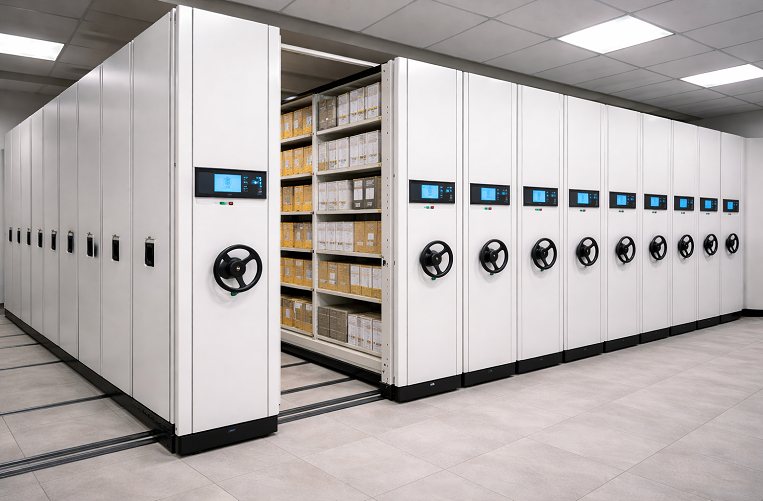
A mobile system keeps the same shelving bays but mounts them on carriages that roll along floor-mounted rails. The banks park with a few centimeters between them, and a mechanical or motorized drive slides the block apart to open one aisle at a point you choose. Three things follow from that:
One aisle serves the whole block. You are no longer paying for an aisle per bank, only for the aisle you are standing in.
The floor becomes storage. Space that was circulation becomes shelf face, which is where the 50–80% capacity gains come from — MINNO rates the system at up to 80% more capacity than conventional shelving in the same footprint.
Retrieval stays physical. Nothing about the records changes: same folders, same boxes, same order. Staff walk to an aisle, open it, and pull the file. That matters in regulated environments where the record itself cannot move to a digital system yet.
The trade-off is honest and worth stating up front: mobile shelving concentrates weight. A packed block of steel shelving on rails loads the floor far more than the same volume of fixed shelving, and the rails have to be level and flat within a tight tolerance or the carriages bind. Those two conditions — floor capacity and floor flatness — decide more projects than the shelving specification does.
The Aisle Arithmetic That Justifies the Purchase
Buyers rarely need a brochure to be convinced; they need the arithmetic for their own room. The calculation is simple enough to do on a site visit.
Assume banks 560 mm deep — the depth of this system — and a 900 mm (3 ft) working aisle, which is a normal figure for document storage. Fixed shelving needs a bank plus a dedicated aisle per cycle: 1,460 mm of depth for every bank. Mobile shelving packs the banks and needs one aisle for the entire block.
Take a room 4.5 m deep:
Same room, six banks instead of three — double the shelf face with no construction work. That is the theoretical ceiling, and it is why the manufacturer's own figure of up to 80% should read as conservative rather than optimistic: real installations give back part of the gain to clearance between parked banks, rail ends, and rooms that need a second accessible aisle. The number that matters in your business case is not the percentage; it is how many linear meters of shelf you gain per square meter of floor, and whether that defers a move, a lease extension, or an off-site storage contract.
One caveat on the arithmetic: some rooms need two accessible aisles at once — a safety requirement in occupied spaces, or a workflow requirement where two clerks retrieve simultaneously. Two aisles halve the gain. Decide the accessible-aisle count before you approve the layout, because it is the single input that changes the answer most.
Specifications at a Glance
Two figures deserve attention. The 2300 mm height is a working height, not a storage height — the top shelf has to be reachable, and at 2.3 m the practical compromise is a step stool for the top level rather than a library ladder. And the 0.8–1.2 mm steel range is a span, not a guarantee: for dense document loads, specify the upper end of that range for shelf pans and uprights and confirm the per-shelf load rating in writing, since that is the number that actually determines whether a bay holds bankers boxes or bound ledgers.
Manual, Electric, or Smart: Choosing the Drive
The drive is the biggest line-item difference between two otherwise identical systems, and the wrong choice is expensive in both directions.
Manual handwheel
A handwheel (or direct push, on lighter bays) costs the least and needs no power, no controller, and no commissioning. It suits rooms with low retrieval frequency — the classic case being a records room where staff pull files a few times a day — and it is the right answer when the room has no reliable power or when the building will not support installed electrical work.
The limitation is effort, not capability: moving a loaded block by handwheel is real physical work, and staff will resist a system that feels heavy. If the room serves more than two or three people working simultaneously, manual stops making sense.
Electric motorized
Motorized drives move the block on command, cut the physical effort, and pair with the safety package that matters most in occupied rooms: infrared or sensor detection that stops the carriage when someone is in the aisle. This is the standard choice for hospital record rooms, busy registries, and any archive with frequent retrieval.
Specify the safety interlocks explicitly — the aisle-entry sensors, the anti-pinch locks at track ends, and the emergency stop. On an electric system these are not accessories; they are what makes the product legal to operate around staff.
Smart
A smart system adds a controller: touchscreen operation, RFID or card authorization for who opens which section, aisle logging, and remote monitoring. The value is not convenience — it is auditability. In a compliance-driven archive (patient records, legal case files, personnel files), knowing who opened which range and when is often the actual requirement, and a smart controller delivers it without a separate access-control project.
Be honest about the cost curve: smart adds electronics, commissioning, software, and a support relationship. If your requirement is "store more files in this room," a manual or electric system does it. If your requirement is "prove who accessed the file and when," smart is the only option that answers it.
Steel, Finish, and Safety: What to Specify
Steel thickness and load rating
The 0.8–1.2 mm range covers everything from light periodical storage to loaded document bays. Ask for the per-shelf uniformly distributed load rating and the per-bay total load, not just the sheet thickness — thickness without a rating tells you nothing about whether a bay will hold a row of bankers boxes without deflecting. Deflection is the failure mode you actually notice: a shelf that bows means folders wedge and the aisle no longer closes cleanly.
For context on how dense document storage gets, a standard letter-size bankers box of files runs roughly 15–20 kg. Ten boxes per shelf across five shelves is more than 750 kg on a single bay. Any supplier quoting a mobile system should be able to put their bay rating next to that arithmetic without hesitating.
Powder coating and the working environment
The electrostatic powder coat is the right finish for an archive: it resists the scuffing that comes from constant folder handling and wipes clean. Specify the RAL color at order time — light colors make an archive room feel less like a bunker and make dust visible for cleaning, while darker colors hide handling marks. Avoid anything that requires solvent cleaning; a dry or barely damp cloth is the whole maintenance routine.
Safety devices
The system's risk profile is the moving block, so the safety package deserves a line-item review:
Anti-tilt protection keeps bays stable when the block is open and a shelf is loaded unevenly.
Anti-pinch locks at track ends prevent a carriage from closing on someone working at the end of an aisle.
Infrared or presence sensors stop movement when a person or object is in the aisle — non-negotiable on electric and smart systems.
Emergency stop at the control point, within reach.
If a quotation does not list these, it is not a cheaper system — it is an incomplete one.
Centralized locking and confidentiality
Mobile shelving's security feature is the ability to lock an entire range with one action rather than locking each bay. That is what makes it credible for personnel files, patient records, and case files: at end of day, one lock secures the block. Individual section locks remain available where a department needs its own key. Decide the locking model before manufacture, because it changes the hardware, not just a setting.
Dust and humidity options
For sensitive material — older manuscripts, photographic archives, compliance records in humid climates — dust-proof and humidity-resistant configurations are available. Treat these as a system decision rather than an accessory: sealing a block changes airflow, which is why the room's HVAC behavior should be part of the conversation rather than an afterthought.
Where the System Pays Back
Seven settings account for most installations, and the economics differ in each.
Corporate and government archives. Contracts, personnel files, and historical records in volumes that outgrow the room. This is the classic case where mobile shelving defers an off-site storage contract, and the payback is measured in avoided monthly fees rather than shelf cost.
Hospital and clinic record rooms. Patient files, imaging records, and administrative documents, where retrieval frequency justifies electric drive and the safety package is a compliance issue, not a convenience.
University and school registries. Transcripts, admission files, and academic records — dense, long-retention, and accessed in bursts at term boundaries. Electric drive with a smart layer handles the audit requirement.
Libraries and research centers. Back-run periodicals, theses, and low-circulation collections. Manual drive is often the right call here: retrieval is infrequent and the cost difference buys more shelf.
Law firms. Case files and evidence collections, where centralized locking plus access logging is the whole value proposition.
Museums and cultural institutions. Catalogues, restoration records, and stored collections in controlled environments, where dust and humidity options matter as much as capacity.
Enterprise records and engineering stores. Drawings, contracts, compliance material, and spare parts that must be retained physically. Large-format material is the awkward case: blueprints and drawings do not live well in standard document bays, and the practical answer is usually a compact system for the bulk plus flat-file drawers for oversized sheets kept in the working area.
That split is worth planning explicitly: mobile shelving is at its best on the low-access bulk — the 70–80% of records that are retained but rarely pulled. Active files that circulate daily belong in locking filing cabinets near the people who use them. Putting daily-use files inside a compact system is the most common layout mistake in these projects, and it shows up as staff leaving the aisle open all day.
What Drives the Price
There is no list price for a system like this, and any supplier who quotes one before seeing your room is guessing. The cost is built from five inputs:
Drive type. Manual to electric to smart is the largest single step, because it adds motors, controls, sensors, and commissioning.
Bay count and rail length. The system is priced roughly on shelf linear meters plus rail — more banks, more cost, but the per-bank cost falls as the block grows.
Steel specification. Thickness and load rating scale the material cost; heavy-duty document loads cost more than periodical storage.
Safety and access features. Sensors, interlocks, RFID, and touchscreen control all land in the quotation.
Site work. Rail installation, floor preparation, and any floor reinforcement sit outside the shelving price — and this is the line item most often underestimated.
Ask for a quotation broken into equipment, installation, and site preparation as three separate figures. A single lump sum hides the part that grows.
Site Readiness: The Part Buyers Get Wrong
The most common cause of a delayed or disappointing compact shelving project is not the shelving — it is the room.
Floor load capacity. A packed block of steel shelving is heavy. Have a structural engineer confirm the slab can take the concentrated load, especially on upper floors and in older buildings with suspended slabs. If reinforcement is needed, that work has to happen before the rails go down, and it belongs in the project budget from day one.
Floor flatness and level. Rails must be level and flat along their full length, or carriages bind and the drive loads up. New slabs are usually fine; old floors with patching, drains, or settlement are not, and grinding or self-leveling is a real cost.
Ceiling height. The unit is 2300 mm before you add rail height and any clearance for installation. Measure to the lowest obstruction — light fittings, sprinkler heads, ductwork — not to the slab.
Access for delivery and installation. A 130.5 kg package per unit and long rails mean the route from truck to room matters: door widths, lift capacity, stair turns, and whether a panel can be carried in knocked-down. Knocked-down structure is what makes most retrofit installations possible; confirm the largest panel dimension against your narrowest doorway.
Obstructions. Columns, radiators, doors, and electrical panels interrupt rail runs. Measure them into the layout, because a rail that stops short of a column wastes the bays behind it.
Maintenance and Daily Operation
A compact system is low-maintenance by design, but not zero-maintenance, and the routine differs by drive type.
Daily. Close aisles when not in use — an open aisle defeats the capacity gain and, on electric systems, invites sensor faults from objects left in the gap. Keep the floor in the aisle clear of boxes and paper; anything on the floor becomes a sensor trip or a trip hazard.
Monthly. Inspect the rails for debris — grit on a rail is the most common cause of a stiff carriage — and wipe them down. Check that the anti-pinch locks and sensors respond. On manual systems, listen for grinding: it usually means a rail obstruction or a loose carriage wheel, and it gets worse rather than better.
Annually. Have the drive and safety devices inspected by a technician, check shelf and upright fixings for loosening under load, and confirm the load rating is still respected — archives drift upward in density as boxes get added to shelves that were already full. Re-level check on rails if the building has settled.
Operationally. Assign the aisle-open rule and the locking routine to a named person. Most compact-shelving complaints in practice trace to a process gap rather than a hardware failure: someone leaves the block open, the next person cannot find the file, and the system gets blamed.
Frequently Asked Questions
How much space does a mobile shelving system actually save?
MINNO rates the system at up to 80% more storage capacity than conventional fixed shelving in the same footprint, and the category figures given are 50–80% space saving depending on layout. The arithmetic sets the ceiling: with 560 mm banks and a 900 mm aisle, a 4.5 m deep room fits three fixed banks or six mobile banks — double the shelf face. Real installations give part of that back to clearance and to any second accessible aisle, which is where the 50–80% range comes from.
Manual, electric, or smart — which should I choose?
Choose manual for low-frequency retrieval where cost and simplicity dominate, such as back-run periodicals or an archive pulled a few times a day. Choose electric where retrieval is frequent or the room serves several people, because it brings the sensor safety package that occupied rooms need. Choose smart when the requirement includes audit — knowing who opened which section and when — which is common in patient records, legal files, and personnel files.
How much weight can it hold?
The system is specified at 0.8–1.2 mm steel, and the load rating depends on the configuration you order. Ask for the per-shelf uniformly distributed load and the per-bay total in writing before approving a layout. As a working reference, a letter-size bankers box of files weighs roughly 15–20 kg, so ten boxes across five shelves is over 750 kg on one bay — that arithmetic is the conversation to have with the supplier.
Does the floor need reinforcing?
Often it needs checking, and sometimes it needs work. A packed block of steel shelving concentrates load far more than fixed shelving, so have a structural engineer confirm slab capacity before purchase — especially on upper floors and in older buildings. Rail installation also requires a level, flat floor, which can mean grinding or self-leveling. Both belong in the project budget, not the contingency.
Can it be installed in an existing room?
Usually yes, and knocked-down structure is what makes it practical: panels ship flat and assemble in the room, so narrow doors and stair turns are less of a blocker. Confirm the largest panel dimension against your narrowest access point, measure ceiling height including light fittings and sprinklers, and map columns and radiators into the rail layout before ordering.
Is it secure enough for confidential records?
Yes, when specified correctly. The system supports centralized locking so an entire range secures with one action at end of day, with individual section locks where departments need separate keys. For audit requirements, add RFID or card authorization on a smart controller, which logs which section was opened and by whom.
What certifications and customization are available?
The system is certified to ISO 9001 and ISO 14001. Customization covers bay count and rail layout, shelf heights and depths, steel thickness within the 0.8–1.2 mm range, RAL colors, branding, and smart features. Because it is built to order, the specification — not a catalog number — is what you are buying.
How is it shipped and installed?
Units ship knocked down, with a single package measuring 91 × 56 × 60 cm at 130.5 kg gross. Installation covers rail fixing, bay assembly and alignment, drive commissioning, and safety device testing. For project work, ask for a quotation split into equipment, installation, and site preparation so you can see which line carries the risk.
Planning an archive room, records room, or library store? Send the room dimensions, the depth and type of material you are storing, and whether you need manual, electric, or audit-logged access, and MINNO will return a layout and a costed quotation covering bays, rails, installation, and site preparation. Start from the MINNO Mobile Shelving System product page — or browse the full mobile shelving range and the wider metal cabinet catalog if part of the collection stays in active filing.
Our Contact
Minno Furtniture
Customize smart storage lockers,parcel delivery lockers, key management cabinet,Vending machines,Office/School and home furniture.
-
Call For Inquiry
-
Send Us Email
sales@buysmartlocker.com
Need Help For Project!
We are ready to help your next projects, let’s work together
 WhatsApp
 sales@buysmartlocker.com
 +8613213557186