

News
30
Jun
Mobile Shelving Systems: Why Archives, Libraries, and Records Rooms Are Quietly Running Out of Space
There's a particular kind of problem that creeps up on facilities managers, records administrators, and library directors without much warning. Storage capacity isn't something that fails suddenly. It erodes slowly, one filing cabinet and one new acquisition at a time, until someone finally walks into the records room and realizes there's nowhere left to put anything.
By that point, the usual responses are all expensive and all unsatisfying. Lease more square footage. Build an annex. Start digitizing everything and hope the budget holds. Or — the option most institutions arrive at eventually, often later than they should have — switch from static shelving to a mobile shelving system.
This article is about that last option, what it actually involves, and why it tends to be the most cost-effective answer for organizations sitting on large volumes of physical records.
The Core Problem With Static Shelving
Conventional fixed shelving has a structural inefficiency built into it that's easy to overlook until you start doing the math.
Every aisle between static shelving units is dead space. It has to be wide enough for a person to walk through, which means roughly half of any given storage room's footprint is dedicated to access rather than storage. Double the shelving, and you've doubled the aisle space too. The ratio doesn't improve as the room gets bigger — it just repeats the same inefficiency at scale.
For archives, records rooms, and library stacks where the goal is maximum retrievable storage per square meter, this is a serious constraint. A room that looks full of static shelving might genuinely be storing less than half of what the same floor space could hold under a different system.
How a Mobile Shelving System Solves It
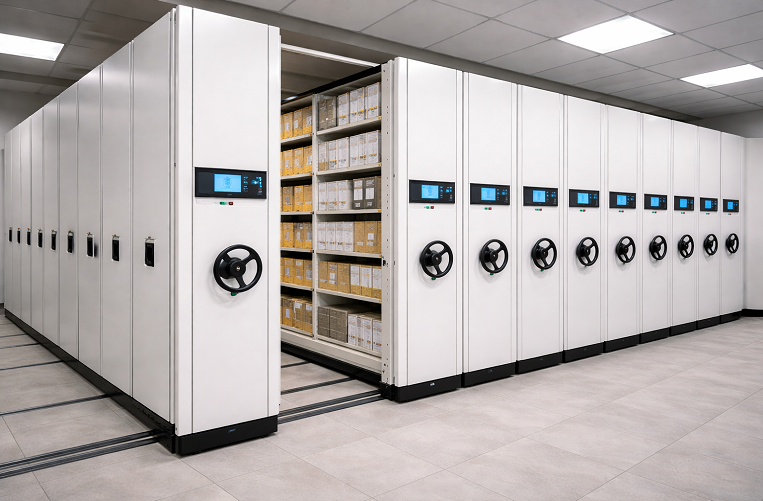
A mobile shelving system — sometimes called a compact archival system or high-density mobile storage — removes the need for fixed aisles altogether. Shelving units are mounted on carriages that glide along floor-mounted rails. Instead of every row having its own permanent access aisle, a single moving aisle opens wherever and whenever it's needed.
The practical result is a capacity increase of up to 80% compared to conventional static shelving in the same physical space. That figure is the reason mobile shelving has become close to standard in any institution that has seriously evaluated its storage economics — the alternative of leasing additional space or building an annex almost never compares favorably once the real numbers are run.
The MINNO Mobile Shelving System is built around this principle, with a reinforced steel structure designed to carry full archival loads without sacrificing the smooth gliding mechanism that makes the high-density layout work in daily use.
What's Actually Inside the System
It's worth being specific about what separates a well-engineered mobile shelving system from a basic one, because the difference shows up in years of daily use, not on a spec sheet at the point of purchase.
Structural steel and load capacity
The MINNO system uses reinforced steel frames and panels throughout, built to carry full archival loads — boxes, bound volumes, binders, and dense paper records — without flexing or sagging over time. Material thickness runs between 0.8mm and 1.2mm depending on configuration, and the surface finish is an environmental protection powder coating, which matters for long-term durability in rooms that may not always have ideal climate control.
Movement mechanism
Access happens through ergonomic handwheels for manual systems, or electronic-assisted moving mechanisms for powered configurations. Anti-tilt protection and safety sensors are built into the mechanism to prevent the kind of accidents that can happen when heavy shelving rows are in motion near people. This isn't a minor detail — any institution evaluating mobile shelving should ask directly about the safety mechanism before purchasing, because the consequence of getting this wrong is a genuinely dangerous piece of furniture.
Adjustment flexibility
The system supports three control methods: manual, electric, or smart. Manual handwheel operation suits lower-traffic archives where retrieval happens occasionally. Electric assistance becomes worthwhile once the rows are heavy or the retrieval frequency is high enough that manual effort adds up across a working day. Smart configuration — touchscreen control, RFID-based authorization, or remote-controlled aisle opening — is increasingly common in institutions that also need to track who accessed which section and when.
Modular and customizable layout
Shelf heights and depths can be configured to match what's actually being stored. Standard document boxes need a different depth than bound periodicals; oversized items like blueprints, architectural drawings, or media storage formats need their own configuration entirely. The system is designed around this kind of flexibility rather than forcing every institution into one fixed shelf profile.
Centralized locking
An integrated locking function can secure an entire row or section at once, rather than requiring individual locks on individual shelves. For archives holding classified material, personnel records, financial documents, or anything else with a confidentiality requirement, this is the feature that turns a storage system into a genuinely secure one.
Climate and environmental adaptability
The structure is designed to support airflow rather than trap it, and can be configured with dust-proof or humidity-resistant features for sensitive archival material — photographic collections, historical documents, or anything else where environmental degradation is a real risk over years of storage.
Where Mobile Shelving Systems Actually Get Used
The application list for high-density mobile shelving is broader than most people initially assume, largely because almost every institution accumulates more physical records than it originally planned for.
Corporate and government archives. Classified documents, employee records, financial reports, and historical institutional data all need secure, space-efficient, long-term storage. Government records retention requirements in particular tend to mandate physical copies for periods that make density planning essential from the start.
Libraries and research centers. Book collections, periodical runs, thesis archives, and rare manuscript collections benefit doubly from mobile shelving — not just the space savings, but the ability to secure specific sections (rare collections, restricted access materials) independently from general circulation stock.
Hospitals and medical records departments. Patient files, medical histories, imaging records, and administrative documentation accumulate at a volume that most hospital facilities planners underestimate at the design stage. Mobile shelving is frequently the retrofit solution when a records room that seemed adequately sized five years ago no longer is.
Universities and schools. Student transcripts, admission files, academic publications, and administrative paperwork all require long-term retention, often for the entire span of a student's enrollment plus additional years after graduation. Mobile shelving allows registrar's offices and administrative departments to handle growing student populations without expanding their physical footprint.
Legal and law firms. Case files, evidence collections, client documents, and litigation records require both secure storage and reliable retrieval — a combination that mobile shelving with centralized locking handles well, particularly for firms with active litigation requiring fast access to specific case material.
Museums and cultural institutions. Catalogs, restoration records, special collections documentation, and historical artifact storage all benefit from the combination of density, security, and environmental control that a properly configured mobile shelving system provides.
Enterprise data management and compliance storage. Industries with hard-copy retention requirements — engineering drawings, signed contracts, regulatory compliance materials — use mobile shelving as the physical backup layer beneath their digital systems, particularly where regulations require an original physical document rather than a scanned copy.
Smart Access: Where Mobile Shelving Is Heading
The optional smart access layer is worth a closer look, because it's increasingly the differentiator between basic mobile shelving and a system that integrates with how modern institutions actually manage access and accountability.
Electronic touchscreen control allows a single interface to manage aisle opening across an entire installation, removing the need for staff to physically operate handwheels row by row. RFID-based authorization means access to specific sections can be restricted to authorized personnel, with the system logging who opened which row and when — relevant for any archive handling sensitive or regulated material. Remote-controlled aisle opening extends this further, allowing authorized staff to open the correct row before they even arrive at the storage room, reducing retrieval time in high-volume environments.
For institutions evaluating whether to specify smart access at the point of purchase versus a purely manual system, the relevant question is usually about future-proofing. Manual systems are simpler and cheaper upfront. Smart-enabled systems cost more initially but tend to pay that difference back through reduced retrieval time and improved access accountability — particularly in environments where audit trails for document access matter.
Specifications and Customization
The standard MINNO Mobile Shelving System configuration runs 2300mm high, 560mm deep, and 900mm wide per unit, though the modular design means actual installation dimensions are determined by room size and the number of units specified rather than fixed to a single footprint.
Material is metal throughout, with thickness configurable between 0.8mm and 1.2mm depending on load requirements. The structure ships knocked-down for efficient freight and is assembled on-site, which keeps shipping costs proportional to actual material rather than to the assembled footprint of a large installation. Surface finish is available in any RAL color specification, and certification under ISO9001 and ISO14001 standards is standard across the MINNO manufacturing process.
Because every archive, library, and records room has a different combination of document types, retrieval frequency, available floor space, and security requirements, MINNO approaches mobile shelving as a configured system rather than a fixed product. Structure design, load capacity, control method, and smart feature integration are all specified to the actual deployment rather than chosen from a limited catalog.
The Real Comparison: Mobile Shelving vs. Expanding Your Space
For institutions facing a genuine storage capacity problem, the comparison that actually matters isn't "mobile shelving versus doing nothing." It's mobile shelving versus the realistic alternatives: leasing additional storage space, constructing an annex, or undertaking a large-scale digitization project to reduce physical volume.
Leasing additional space carries an ongoing cost that compounds every year the lease continues, with no improvement to the underlying inefficiency of the storage method itself. Construction is a capital project with a long timeline and a cost that rarely comes in under the original estimate. Digitization is valuable for access and backup purposes, but for many institutions — particularly those with legal, regulatory, or historical preservation requirements — it doesn't eliminate the obligation to retain physical originals.
Mobile shelving, by comparison, is a one-time capital investment that directly addresses the underlying inefficiency: it doesn't just store more, it stores more in the same square footage you already have, often without any need for additional real estate at all. For most institutions running the numbers seriously, this comparison is what tips the decision.
A Practical Note Before You Specify a System
A few questions are worth getting clear answers on before finalizing a mobile shelving order, regardless of which manufacturer you're considering:
What's the actual load capacity per shelf, and has it been tested under full archival density? Paper records are heavier than most people estimate in aggregate — a fully loaded row of bound volumes or document boxes can represent a substantial structural load, and the system needs to be rated for it, not just for display purposes.
What's the safety mechanism for the moving rows, and what happens if someone is in the aisle when it's activated? This should have a clear, specific answer, not a general assurance.
Can the shelf configuration be changed after installation if storage needs shift? Institutional storage needs evolve. A system that's rigid after installation creates the same problem you're trying to solve, just on a longer timeline.
What's the manufacturer's experience with your specific use case? A system designed primarily for retail storage and adapted for archival use behaves differently than one engineered from the start for the load and access patterns of a records room or library stack.
The MINNO team can walk through all of these directly for any specific installation under consideration — the contact details are below.
Frequently Asked Questions
Q: How much more storage capacity does mobile shelving actually provide compared to static shelving?
Up to 80% more, in the same physical footprint. The exact figure depends on the room's original layout and how inefficiently the existing static aisles were spaced, but institutions moving from fixed shelving to a mobile system consistently find they can store significantly more material without expanding their floor area at all. In many cases, this also frees up part of the existing room for something other than storage.
Q: Is mobile shelving safe? What stops a row from closing on someone while they're inside the aisle?
Properly engineered systems include anti-tilt protection and safety sensors that detect when a person or obstruction is present in the moving aisle, preventing the row from closing. This applies to both electric and smart-controlled systems. For manual handwheel systems, the mechanical resistance and locking mechanisms are designed so that rows can't be moved unintentionally. Any institution evaluating a system should ask the manufacturer directly how the safety mechanism is tested and rated — this isn't a feature to take on faith.
Q: Can we choose manual operation now and upgrade to electric or smart control later?
This depends on how the base structure is specified at the time of order. Some configurations are designed to accommodate a later upgrade to electric or smart-assisted movement; others are built specifically around the control method chosen at purchase. If future flexibility matters for your installation, raise it during the initial consultation rather than after the system is installed.
Q: How much weight can each shelf hold?
Load capacity depends on the steel thickness and structural configuration specified for the installation, which typically ranges from 0.8mm to 1.2mm depending on requirements. Archival paper records, bound volumes, and document boxes can represent significant cumulative weight across a fully loaded row, so load capacity should be confirmed against your actual material type and density — not assumed from a generic spec sheet.
Q: Does mobile shelving work in rooms with uneven floors or existing structural limitations?
Floor-mounted rail systems generally require a level, stable surface for smooth operation, and floor loading capacity needs to be assessed for the combined weight of the shelving structure and its contents — particularly in older buildings or upper-floor installations. A site assessment is the standard first step before finalizing a configuration, and this should be part of any serious quote process.
Q: How long does installation take, and is the room out of use during that time?
Because the structure ships knocked-down, on-site assembly time depends on the scale of the installation — a single records room differs significantly from a multi-row library stack. Most installations are planned to minimize disruption to ongoing operations, but a room undergoing a full shelving replacement will typically need to be inaccessible for at least part of the process. This timeline should be confirmed during the quoting stage based on your specific room and order size.
Q: Can the system be expanded later if our storage needs grow further?
Modular configurations are generally designed to allow additional rows or units to be added to an existing installation, provided the floor space and rail infrastructure can accommodate the expansion. This is worth discussing at the time of the original installation, even if the expansion isn't needed immediately — planning the rail and floor specification with future growth in mind avoids a more disruptive retrofit later.
Q: What's the difference between RFID-based smart access and a simple centralized lock?
A centralized lock secures an entire row or section with a single physical or electronic lock, controlling whether the row can be accessed at all. RFID-based smart access goes further, identifying who is requesting access and logging that activity automatically. For archives with general confidentiality needs, a centralized lock is often sufficient. For institutions with regulatory audit requirements, or those needing to demonstrate exactly who accessed specific records and when, RFID-based access control provides the accountability layer that a simple lock cannot.
For specifications, configuration options, and a quote on the MINNO Mobile Shelving System, visit buysmartlocker.com
Our Contact
Minno Furtniture
Customize smart storage lockers,parcel delivery lockers, key management cabinet,Vending machines,Office/School and home furniture.
-
Call For Inquiry
-
Send Us Email
sales@buysmartlocker.com
Need Help For Project!
We are ready to help your next projects, let’s work together
 WhatsApp
 sales@buysmartlocker.com
 +8613213557186