

News
02
Nov
Table Top Coffee Vending Machine: Sizing, Serving, and Payback for a 420 mm Counter
A table top coffee vending machine is the format that fits where a floor-standing machine cannot: a breakroom counter, a hotel lobby side table, a showroom reception desk, a clinic waiting area. It gives up floor space and gains a footprint — 420 × 450 mm — while keeping the parts that make a vending machine worth owning: a grinder, a payment interface, and remote monitoring.
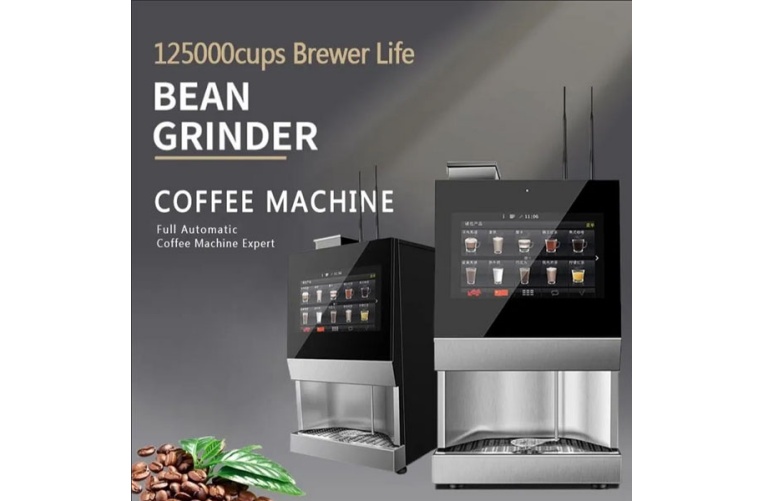
The MACES4C-00 is that machine. A 15.6-inch touchscreen, one bean hopper with a built-in grinder, three instant powder canisters, up to ten drinks, 40 seconds for a coffee, 20 seconds for an instant drink, and a published price of US$2,100–2,500. It weighs 57 kg and stands 700 mm tall.
The useful question is not whether it makes good coffee — it is whether it fits your counter, your drink menu, your refill routine, and your volume. Those four things decide whether a machine like this becomes an asset or a 57-kilogram paperweight, and each of them can be calculated before you order.
What This Format Is Actually For
There are three ways to put coffee in a building, and they are not interchangeable.
A bean-to-cup machine with no payment serves staff for free. No card reader, no telemetry, no reconciliation. Cheap to run, but it is a perk, not a service.
A floor-standing vending machine serves a lobby or a corridor. It holds more, takes 0.5 m² of floor, and needs to justify its footprint with volume.
A table-top vending machine sits in between. It takes a counter, holds enough for a day or two, and — this is the point — it can take payment. That makes it viable in places where free coffee is not: a hotel lobby, a car dealership, a hospital outpatient wing, a co-working entrance, a factory gate office.
The MACES4C-00 is built for that middle case. The published applications are office coffee service, hospitality and HoReCa, commercial and retail spaces, and small businesses — which is another way of saying: places with 20 to 80 people passing a counter, not places with a dedicated café.
The trade-off is capacity, and it is worth stating plainly. One bean hopper of 1 kg and three 2-litre powder canisters is a small inventory. If the site needs 200 cups a day, this machine will be refilled twice a day and someone will resent it. If it needs 40 to 80, it is the right size.
Specifications at a Glance
Two specification notes that matter more than they look.
There is no tea brewer. The spec sheet says so explicitly. Tea on this machine means instant powder from a canister, not a leaf brew. If your site expects proper tea, that expectation will not be met, and no amount of menu labelling fixes it.
There is no fresh-milk module. Milk comes from powder. That simplifies hygiene enormously — no milk line to flush, no dairy residue — but it means no fresh-milk flat white. The range includes a separate fresh-milk variant (MACES4C-M-00) for sites where that matters.
Ten Drinks From One Grinder and Three Canisters
The menu structure explains both the machine's flexibility and its ceiling.
From the grinder: espresso, and anything built on it — americano, espresso macchiato, lungo. One hopper means one bean at a time, so choose a medium roast that works both as espresso and with milk; a very dark roast that suits a ristretto will taste harsh in a large milky drink.
From the three powder canisters: the instant side of the menu — hot chocolate, milk tea, chai, powdered cappuccino, and similar. Two mixers handle powder and water blending.
Ten selections total, which sounds generous until you try to fill it. A realistic allocation: three espresso-based drinks, one long black, two milk-based powders (cappuccino, latte), hot chocolate, milk tea, hot water, and one seasonal slot. That is nine or ten, and it is enough for most sites — but it is not a café menu, and the person specifying it should decide the list before installation rather than letting it default.
Strength adjustment matters here. The UI allows coffee, sugar, and milk to be set per drink, which is what makes a powder-based menu tolerable: the same canister can serve a strong office cappuccino and a mild one for a waiting room, as separate selections.
What this configuration cannot do, and buyers routinely miss:
Two different beans. One hopper. If half the site wants a dark roast and half a light one, one group will be unhappy.
Fresh milk. Powder only, on this model.
Leaf tea, chai from leaf, or matcha. Powder only.
Cold drinks. The category page mentions temperature versatility for the range, but this model's specification is a hot-beverage brewer; confirm cold capability in writing if you need it, and do not assume it.
Footprint, Weight, and Counter Reality
The dimensions are friendly. The weight is not.
Footprint: 420 × 450 mm is roughly the size of a large microwave, and the 700 mm height means it sits below eye level for most users, with the 15.6-inch screen tilted up — workable on a standard 900 mm counter, less comfortable on a low table.
Cup clearance: 70 to 158 mm. That upper figure matters: 158 mm takes a tall travel mug, which means staff can use their own insulated cup instead of a paper one. Below 70 mm nothing fits, so the drip tray position (not the tallest cup) becomes the constraint — check that the tray can be removed or lowered if you serve 60 mm espresso cups.
Weight: 57 kg, empty, before beans, powder, and water. That is the specification most sites ignore, and it causes the two most common installation problems:
The counter is not rated for it. A 57 kg point load on a lightweight worktop — chipboard with a laminate skin, a floating shelf, a hollow reception desk — will eventually sag or delaminate. Specify a solid base, and if the counter is more than a metre long and unsupported, add a leg under the machine position.
Nobody can move it for cleaning. At 57 kg it does not slide. If the machine sits on a counter that needs daily wiping behind and beneath, plan a position where the machine's own cleaning routine is enough, or accept that it gets pulled forward twice a year, not twice a week.
Clearances to plan in writing: at least 100 mm above the machine for the hopper lid to open fully, 450 mm in front for the cup and the user's shoulders, and a power socket within reach that is not behind the machine — a 57 kg unit is not something you want to pull out to reach a plug.
Throughput: How Many Cups, and When You Need Two
The published brew times give a hard ceiling: 40 seconds per coffee means no single group could exceed about 90 coffees an hour even with instant selection; 20 seconds per instant drink gives about 180.
Those are theoretical. Real throughput is lower, because every user adds selection time and, if payment is enabled, transaction time. A practical planning figure for a table-top machine is closer to half the theoretical rate during a rush.
That is enough for most sites, because the binding constraint is rarely hourly throughput — it is the 8:00 to 9:30 window. If 60 people arrive within 90 minutes, that is 40 cups an hour, comfortably inside the machine's capability, but only if the queue can form. Two practical consequences:
One machine, one queue. Position it so people queue sideways along a counter, not backwards into a corridor.
Peak, not daily volume, decides the second machine. 40 cups a day spread over eight hours is one machine. The same 40 cups arriving between 08:00 and 08:30 is a queue problem no machine solves — a second unit or a pre-order habit does.
If your site runs two shifts with a shift change, that changeover is the peak to plan for, not the daily total.
Refill Planning: What "1 kg Hopper" Means in Cups
This is the arithmetic that decides who owns the job of looking after the machine.
Beans: a 1 kg hopper, at 7 g for a single espresso, yields about 140 coffees. At 14 g for a double, about 70. At a mixed 10 g average, roughly 100 cups per fill. So a site serving 60 coffee drinks a day refills beans every day and a half to two days.
Powder: three 2-litre canisters. Powder density varies, but expect each canister to serve a few dozen cups, and expect the milk-based canister to empty first — it always does.
Water: this is the question to settle before ordering. The specification lists the water tank as optional, which means the machine can be configured either with a tank or plumbed to mains. A tank needs daily filling at 60 cups a day; mains plumbing needs a water connection, a pressure regulator, and a filter, and it removes the daily chore entirely. Ask which configuration is quoted, and ask for the tank capacity if it is a tank.
Cups and condiments: if the machine does not vend cups, someone has to stock them, and that person needs to be named. Machines do not fail because the coffee is bad; they fail because nobody refilled the cups on a Friday.
Payment, Telemetry, and Pricing the Cup
This is where a table-top vending machine differs from a coffee machine, and where most of the specification decisions sit.
Payment hardware is optional. The spec lists bill, coin, and card readers as options, with the IOT payment interface and MDB 4.2 as standard. That gives three operating models:
Free vend. No reader, no reconciliation. Staff coffee, hospitality amenity, showroom courtesy. Simplest and cheapest to run.
Paid, cash. Bill and coin readers. Attractive in some markets, but cash handling means a collection routine, a float, and a lock-box discipline.
Paid, cashless. Card reader plus the standard IOT interface. Best for lobbies and semi-public spaces, and it removes cash handling entirely — but it adds transaction fees and a merchant account to the business case.
Telemetry is standard, but it needs configuring. Wi-Fi and RJ45 are standard, 4G is optional. Remote monitoring and fault alerts only work if the machine is actually online and someone is watching the alerts. Name that person. A fault alert that goes to an unread inbox is worse than no alert, because it creates the illusion of monitoring.
Android on a 15.6-inch screen is what makes menu editing and screen content practical: drink names, prices, and promotional images can change without a technician visit.
The cost-per-cup formula, so you can run it with your own numbers rather than accept anyone's estimate:
cost per cup = (bean price per kg ÷ cups per kg) + (powder cost per canister ÷ cups per canister) + cup + electricity + payment fee (if cashless)
At a 10 g dose, one kilogram of beans yields about 100 cups, so a $20/kg bean costs about $0.20 per cup in coffee. Powder-based milk drinks add a few cents to a few tens of cents depending on the powder. Cups and lids typically cost more than the coffee. Electricity for a machine this size is modest but not zero, because the boiler holds temperature all day — and a machine left on overnight in an empty building is pure waste, which is why the scheduled on/off and cleaning timer matters commercially, not just for hygiene.
Do the sum before choosing a price point. Sites routinely set a lobby price by looking at the café down the street, then discover the machine's own consumable cost is higher than expected because the milk drinks use powder at a real cost per serving.
Table-Top or Floor-Standing: Choosing the Format
The range has three coffee machines, and the choice is about space and menu, not quality.
The rule: choose table-top when the counter is the only space you have and 40 to 80 cups a day is your realistic ceiling. Choose floor-standing when you need volume and can give up floor. Choose the fresh-milk variant only if you can commit to a daily flush — a fresh-milk machine that is not flushed daily is a hygiene incident waiting to be discovered.
Hygiene and Service: What the Auto-Clean Does Not Do
The machine has an auto-clean cycle and scheduled cleaning, which handles the routine rinse of the brew path and mixer. That is genuinely useful, and on a powder-only machine it is close to sufficient.
What it does not do:
Empty and rinse the powder canisters. Powder absorbs moisture and cakes; a caked canister feeds inconsistently and eventually blocks. Weekly, empty, wipe, dry, refill.
Clean the drip tray and cup rest. Daily, or the machine smells before the coffee does.
Descale. Water hardness determines the interval, and the interval is not optional — scale kills boilers, and a boiler is the most expensive part in the machine. Ask for the descaling procedure and the recommended interval for your water hardness at the point of purchase, and check whether your warranty requires documented descaling. Many do.
Clean the grinder. Periodically, with grinder tablets, and more often in humid climates.
Service terms on this model: one year on the whole machine plus one year on core components — boiler, grinder, brewer — with online support and spare parts. Note that this is a component-level warranty, which is better than a blanket one year: the three parts that actually fail are named. Confirm the response process in writing, because "online support" means different things to different suppliers, and a machine down in a hotel lobby is a same-day problem, not a this-week problem.
Site Checklist Before You Order
Measure the counter — 450 mm of depth plus clearance, and confirm the worktop can take 57 kg plus water and consumables.
Confirm the water configuration — tank or mains, and if a tank, its capacity and who fills it.
Confirm payment hardware — free vend, cash, or cashless, and whether the reader is included in the quote.
Decide the ten drinks before installation, not after.
Check the cup clearance against the cups you will actually use — 158 mm is the ceiling.
Ask about descaling — recommended interval for your water hardness, and whether it is a warranty condition.
Confirm the connectivity plan — is there Wi-Fi at that counter, and who receives the fault alerts?
Name the refill owner and the cleaning owner — two names, written down. This single item prevents most of the failures that get blamed on the machine.
Check the power — a socket near the machine, not behind it, and confirm the supply requirement for your region with the supplier.
Confirm the delivery path — 57 kg in a carton will not go up a narrow stairwell on one person's shoulder; plan a trolley and a second pair of hands.
Frequently Asked Questions
How much does this table top coffee vending machine cost?
The published price range is US$2,100–2,500 for the MACES4C-00. That is the machine; add payment readers if you need cash or card, plus the first order of beans, powder, and cups.
How many cups can it make per hour?
The brew times set the ceiling: about 40 seconds per coffee and 20 seconds per instant drink, so roughly 90 coffees or 180 instant drinks an hour in theory, before selection and payment time. Plan on closer to half that during a rush, and treat peak demand rather than daily volume as the reason to buy a second machine.
How big is it and how much does it weigh?
420 × 450 × 700 mm (16.5 × 17.7 × 27.6 in), weighing 57 kg empty. The weight is the specification that causes problems — a lightweight worktop will sag under it, and it cannot be slid out of the way for cleaning. Put it on a solid base.
Does it make fresh-milk lattes?
No. This model uses powder, not fresh milk, and the spec sheet lists no fresh-milk module. If fresh-milk drinks are a requirement, look at the fresh-milk variant in the same range — but plan for a daily milk-line flush, which is not optional.
Can it make tea?
Only as an instant powder. The specification states no tea brewer, so leaf tea is not possible on this machine. Sites that expect real tea should treat that as a firm requirement and pick different equipment.
How often does it need refilling?
The bean hopper holds 1 kg — roughly 100 cups at a 10 g dose, so about 70 doubles or 140 singles. Three 2-litre powder canisters handle the instant side, and the milk powder canister will empty first. A site serving 60 coffees a day refills beans every one to two days.
Does it need a water connection?
The water tank is listed as optional, so either configuration may be quoted. A tank means daily filling at volume; mains plumbing removes that chore but needs a supply, a regulator, and a filter. Confirm which one is quoted and what the tank capacity is before ordering.
Can it take payment and be monitored remotely?
Yes. Android with a 15.6-inch screen, Wi-Fi and RJ45 standard, 4G optional, IOT payment interface and MDB 4.2 standard, with bill, coin, and card readers as options. Remote fault alerts only help if someone actually watches them — assign that to a named person.
One counter, ten drinks, and a machine that can take payment. The MACES4C-00 table top coffee vending machine is US$2,100–2,500, backed by a one-year machine warranty with a second year on the boiler, grinder, and brewer. Tell us your counter dimensions, your daily cup target, and whether you want free vend or cashless, and we will confirm the configuration, the water setup, and the delivery plan before you commit. The full coffee machine range covers floor-standing and fresh-milk formats if this one is the wrong size.
Our Contact
Minno Furtniture
Customize smart storage lockers,parcel delivery lockers, key management cabinet,Vending machines,Office/School and home furniture.
-
Call For Inquiry
-
Send Us Email
sales@buysmartlocker.com
Need Help For Project!
We are ready to help your next projects, let’s work together
 WhatsApp
 sales@buysmartlocker.com
 +8613213557186