

News
28
Jul
The Real Profit Margin Behind a Table-Top Coffee Vending Machine
Coffee is water, beans, milk powder, and a paper cup — and yet it consistently ranks among the highest-margin categories in the entire self-service vending industry. This article looks past the marketing language and works through the actual cost-per-cup economics of a table-top coffee vending machine, using this fully automatic bean-grinding commercial coffee vending machine as the working example. If you're sourcing a commercial coffee vending machine for an office, hotel lobby, retail space, or breakroom, the numbers below will help you model real profit margin before you buy.
By the Numbers: What Coffee Vending Actually Earns
Before looking at this specific machine, it's worth grounding the discussion in industry-wide data, since coffee vending margins are unusually strong compared with snack and drink vending:
Ingredient cost per cup typically runs <cite index="13-1">between $0.08 and $0.30 depending on beverage quality</cite>
Gross margins on premium coffee drinks commonly reach <cite index="14-1">55% to 70%, with product cost around $0.80–$1.50 per cup against a retail price of $3.50–$4.50 or more</cite>
More conservative industry estimates still put typical gross margin at <cite index="15-1">40% to 65% per cup, since ingredient cost for beans or pods, cup, and lid rarely exceeds $0.35–$0.60 against an average sale price of $1.25–$2.50</cite>
Some analyses describe markups of <cite index="19-1">300% or more on a vended cup of coffee</cite>, and others note gross margin figures as high as <cite index="16-1">70–80%</cite> in well-run deployments
Whichever benchmark you use, the pattern is consistent: coffee vending machine profit margin per cup is structurally higher than almost any other unattended retail category — which is exactly why office coffee service (OCS), hospitality, and retail buyers keep gravitating toward tabletop and bean-to-cup machines over pre-bottled beverage vending.
Worked Example: What This Machine Could Earn Per Cup
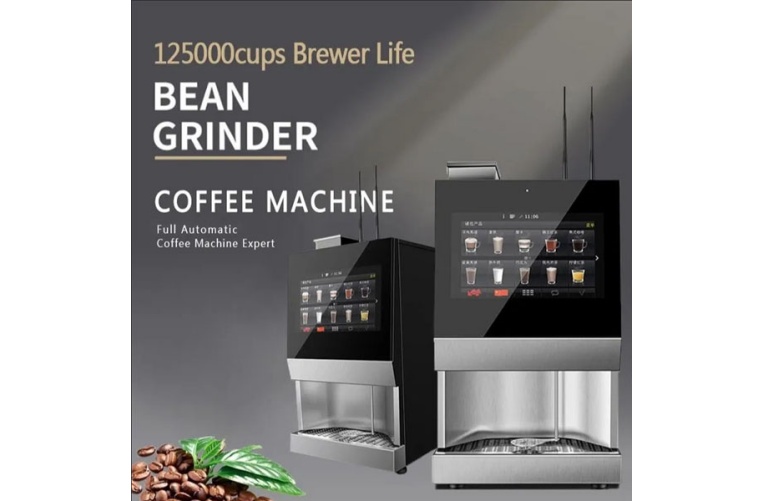
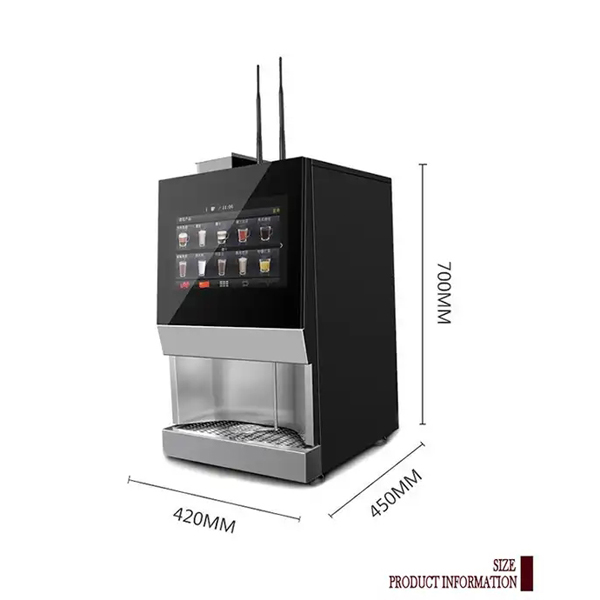
This table-top coffee vending machine (model MACES4C-00) is built around a real espresso-grade brewing system — a piston or magnetic pump as standard, an optional brushless gear pump reaching 20 bar, and an adjustable 8–11 bar brew pressure — combined with a built-in coffee bean grinder and three 2-liter instant powder canisters, supporting up to 10 beverage types. That hardware spec matters directly for margin, because bean-fresh coffee commands a higher retail price than pre-mixed instant vending drinks, without a proportionally higher ingredient cost.
Using a mid-range industry cost assumption for a freshly ground bean-to-cup beverage:
| Variable | Estimate |
|---|---|
| Ingredient cost per cup (beans, milk, cup, lid) | ~$0.30 – $0.50 |
| Typical retail price per cup (office / retail setting) | $1.50 – $3.00 |
| Gross profit per cup | ~$1.20 – $2.50 |
| Approximate gross margin | 55% – 75% |
At a modest 40 cups per day — well within reach for an office breakroom or hotel lobby placement — that gross profit range translates to roughly $48–$100 in daily gross profit, or $1,440–$3,000 per month, before deducting electricity, consumables restocking labor, and any location commission. Industry data backs up this order of magnitude: one operator model shows a machine selling <cite index="20-1">60 cups per day at $2.00 generating about $3,600 in monthly sales and roughly $2,200 in net profit after location commission and operating costs</cite>, while another example shows <cite index="16-1">100 cups per day at $2 generating $6,000 in monthly revenue and net profit of $3,000–$3,500</cite> after supplies and commission.
5 Reasons This Table-Top Coffee Vending Machine Protects Margin
1. Built-In Grinder Increases Perceived Value Without Proportional Cost Increase
Because this machine grinds whole beans on demand rather than relying only on instant powder, it can be positioned and priced as a "freshly ground" or "barista-style" beverage — commanding the higher end of the $1.50–$3.00+ per-cup price range — while the actual ingredient cost increase over instant coffee is marginal. This is one of the most direct margin levers available in coffee vending: upgrading perceived quality without a matching upgrade in cost of goods sold.
2. Ten Beverage Options From One Machine Spreads Fixed Costs Across More Transactions
With one grinder and three separate powder canisters, the machine can serve up to 10 different beverage types — espresso-based drinks, instant options, and mixed beverages — from a single footprint. This lets one machine capture a wider range of price points and customer preferences (some willing to pay a premium for espresso, others wanting a faster $1.50 instant option), increasing total transactions per machine without adding hardware cost.
3. Fast Cycle Times Increase Throughput Per Hour
At roughly 20 seconds for instant beverages and 40 seconds for coffee beverages, this machine can serve a meaningfully higher number of customers per hour than slower commercial units — important during morning rush or meeting-break windows where transaction volume, not just margin per cup, drives total daily profit.
4. Remote Monitoring Reduces the Two Biggest Hidden Costs: Downtime and Wasted Trips
The machine's smart background management system sends alerts when it detects an abnormality, and supports scheduled auto-cleaning appointments. For operators managing multiple placements, this means fewer wasted service visits and faster response to faults — both of which protect net margin by minimizing the downtime that silently erodes monthly revenue on any vending route.
5. Personalized Recipe Control Reduces Waste and Complaints
Customers can personalize coffee strength, sugar, and milk levels directly on the 15.6-inch touchscreen. Letting customers dial in their own preference reduces the rate of "wrong drink" complaints and wasted remakes — a small but real leak in gross margin for any unattended beverage machine.
Where This Machine Delivers the Strongest Margin
Coffee vending profitability depends heavily on placement, not just hardware. Based on typical deployment data, this table-top coffee vending machine performs best in:
Office Coffee Service (OCS) — breakroom placements where daily repeat purchases from the same employees build predictable, recurring transaction volume
Hotels, restaurants, and catering (HoReCa) — lobby or VIP reception placements where guests will pay premium pricing for a fast, high-quality beverage
Retail and commercial spaces — convenience stores, waiting rooms, showrooms, and gyms capturing "coffee to go" impulse purchases
Small businesses and meeting rooms — replacing a traditional coffee pot with a cleaner, self-service alternative for client-facing spaces
High-traffic, captive-audience locations consistently outperform low-traffic ones — one industry breakdown notes that <cite index="15-1">a high-traffic office machine serving 60+ cups daily generates substantially more monthly revenue than a low-traffic breakroom serving 15 cups daily, even though restocking labor cost stays nearly identical</cite>. In other words: for this machine, placement quality is as important to profit margin as the equipment itself.
Frequently Asked Questions
How much profit margin can a table-top coffee vending machine generate per cup?Based on industry benchmarks, gross margin per cup typically ranges from 40% to 75%, depending on beverage type, pricing, and location, with ingredient cost usually staying under $0.50 per cup against a retail price of $1.50–$3.00 or more.
How long does it take to break even on a commercial coffee vending machine?At this machine's US$2,100–US$2,500 price point, and assuming 40–60 cups sold daily at a $1.50–$2.50 average price, operators can realistically expect a payback period in the range of a few months to under a year, depending on location commission and traffic.
Does a built-in grinder actually improve profit margin, or just product quality?Both. Freshly ground coffee supports a higher retail price point than instant-only machines, while the added ingredient cost per cup is minimal — which directly widens gross margin per transaction.
What is the best location type for maximizing this machine's ROI?High-traffic, captive-audience environments — office breakrooms, hotel lobbies, and busy retail or meeting spaces — consistently produce the strongest daily cup volume and therefore the strongest monthly profit.
Get Your Machine and Start Calculating Real Numbers
This table-top coffee vending machine (US$2,100–US$2,500) comes with a 1-year warranty on the full machine plus 1 year on core components (boiler, grinder, brewer), 24/7 online support, and free spare parts coverage for manufacturing defects — reducing the downtime risk that most directly threatens coffee vending profit margin.
Want to model the profit margin for your specific location? Contact MINNO for a customized quote, or browse the full coffee vending machine lineup.
References
How Profitable Is a Coffee Vending Machine? — StackBlitz. https://stackblitz.com/@indiapoojaverma/collections/how-profitable-is-a-coffee-vending-machine
Are Coffee Vending Machines Profitable in 2026? ROI Breakdown & Why AI Robots Are Winning — Financial Content. https://markets.financialcontent.com/wral/article/abnewswire-2026-3-27-are-coffee-vending-machines-profitable-in-2026-roi-breakdown-and-why-ai-robots-are-winning
Coffee Vending Franchise Guide: Costs & Models Explained — VMFS USA. https://vmfsusa.com/blogs/business/coffee-vending-franchise-guide
Are Coffee Vending Machines Profitable? — VMFS USA. https://vmfsusa.com/blogs/business/are-coffee-vending-machines-profitable
Coffee Vending Machines: Build a Passive Income Stream 24/7 — GS Coffee Vending. https://www.gscoffeevending.com/coffee-vending-machines-the-ultimate-guide-to-unlocking-passive-income-in-2025
Coffee Vending Machines Are the Hottest Trend — Here's How Much You Can Earn! — Vendpreneurs. https://www.vendpreneurs.com/p/coffee-vending-machines-are-the-hottest-trend-here-s-how-much-you-can-earn
Table-Top Coffee Vending Machine (Automatic Freshly Ground Coffee Machine with Grinder) — MINNO Furniture. https://www.buysmartlocker.com/coffee_vending_machine/Table-Top-Coffee-vending-Machine.html
Our Contact
Minno Furtniture
Customize smart storage lockers,parcel delivery lockers, key management cabinet,Vending machines,Office/School and home furniture.
-
Call For Inquiry
-
Send Us Email
sales@buysmartlocker.com
Need Help For Project!
We are ready to help your next projects, let’s work together
 WhatsApp
 sales@buysmartlocker.com
 +8613213557186