

News
16
Oct
What Is a Mobile Shelving System? A Complete Guide to High-Density Compact Storage
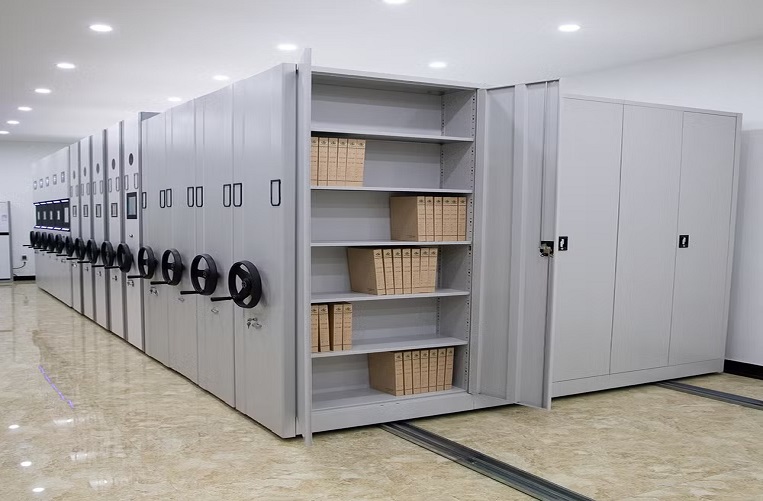
A mobile shelving system, also called compact shelving or an archive compactor, is a high-density storage solution in which shelving units are mounted on movable carriages that glide along floor rails. Because the units can be moved together, the system removes the fixed aisle between every row of shelves and opens only the aisle you need. The result is much more storage in the same room, which is why mobile shelving is widely used in archives, libraries, hospitals, government offices, universities and law firms. This guide explains how a mobile shelving system works, what its parts do, what benefits it offers and where it makes sense.
Table of Contents
What is a mobile shelving system?
How does mobile shelving work?
Main components
Key benefits of high-density mobile shelving
Three control methods: manual, electric and smart
Safety features
Materials, finish and typical specifications
Where mobile shelving is used
Mobile shelving vs fixed shelving
Frequently asked questions
1. What is a mobile shelving system?
In a conventional storage room, every row of shelving needs its own aisle so people can reach the items. In a typical layout, a large share of the floor area is therefore empty aisle space. A mobile shelving system solves this by putting the shelving on carriages that move sideways on rails. Instead of many permanent aisles, there is just one open aisle at a time, and you create it where you need it by moving the units apart.
Manufacturers describe this as high-density storage because the same floor area holds far more shelving. MINNO states that its mobile shelving design can increase storage capacity by up to 80% compared with conventional shelving, while minimizing the footprint. The actual gain depends on room size, layout and the shelving being replaced.
2. How does mobile shelving work?
Rails are installed on the floor, running across the room.
Carriages sit on the rails, and shelving units are mounted on top of them.
Units are pushed together when no one needs access, forming a compact block.
The user opens an aisle by moving the units to create a gap at the required position.
After retrieving or storing items, the user closes the aisle and secures the system if needed.
Depending on the system, the units can be moved by turning a handwheel, by electric assistance at the push of a button, or through a smart control system with touchscreen, RFID authorization or remote control.
3. Main components
| Component | What it does |
|---|---|
| Steel shelving frames and panels | Hold the stored items and carry the load |
| Carriages (movable bases) | Support the shelving and move along the rails |
| Rails | Guide the carriages smoothly across the floor |
| Drive mechanism | Handwheel (manual) or motor (electric and smart) |
| Safety devices | Anti-tilt protection and safety sensors |
| Locking system | Locks a row or section to prevent unauthorized access |
| Control interface (optional) | Touchscreen, RFID reader or remote control for smart systems |
4. Key benefits of high-density mobile shelving
Maximum storage in minimum space. Removing fixed aisles lets you store more records, books or materials without expanding the room.
Strong, durable structure. Reinforced steel frames and panels provide load-bearing capacity and long-term durability, even under full weight.
Easy, safe operation. Ergonomic handwheels or electric-assisted mechanisms make movement easy, and safety features help prevent accidents.
Flexible, modular layouts. Shelf heights and depths can be configured for documents, binders, boxes and specialty items such as blueprints or media storage.
Security. A centralized locking function secures an entire row or section, which protects confidential material.
Environmental adaptability. The design supports air circulation, and dust-proof or humidity-resistant features can be added for sensitive archives.
Better organization. A compact, systematic layout makes records easier to manage and retrieve.
5. Three control methods: manual, electric and smart
Mobile shelving can be configured with three adjustment methods:
Manual: Units are moved by an ergonomic handwheel. This is the simplest and most economical option and works well for lighter loads and smaller installations.
Electric: An electronic-assisted mechanism moves the units at the push of a button, reducing physical effort, which suits heavy loads and long runs.
Smart: Adds intelligent access control such as an electronic touchscreen, RFID authorization or remote-controlled aisle opening, which suits secure and managed archives.
Our companion article, Manual vs Electric vs Smart Mobile Shelving, compares the three in detail.
6. Safety features
Because the units are heavy and move on rails, safety is central to good design:
Anti-tilt protection to keep the units stable
Safety sensors on electric and smart systems to help prevent accidents while the system moves
Locking function to keep units fixed when someone is working in an aisle or when the system is closed
Ergonomic controls that reduce strain on operators
7. Materials, finish and typical specifications
For reference, the MINNO mobile shelving system is built as follows:
| Item | Specification |
|---|---|
| Material | Metal (steel) |
| Thickness | 0.8 to 1.2 mm |
| Sample unit size | 2300 mm high × 560 mm deep × 900 mm wide |
| Finish | Environmental protection powder coating |
| Color | RAL colors |
| Structure | Knocked-down (flat-pack) |
| Adjustment method | Manual, electric or smart |
| Certification | ISO9001 / ISO14001 |
| Brand and origin | MINNO, Henan, China |
A knocked-down structure means the shelving is shipped disassembled in compact packages, which simplifies transport and storage before installation.
8. Where mobile shelving is used
Corporate and government archives: classified documents, employee records, financial reports and historical data
Libraries and research centers: book collections, periodicals, thesis archives and rare manuscripts
Hospitals and medical record rooms: patient files, medical histories and imaging records
Universities and schools: student transcripts, admission files and academic publications
Law firms and legal offices: case files, evidence collections and client documents
Museums and cultural institutions: catalogs, restoration records and special collections
Enterprise data management rooms: hard-copy backup such as engineering drawings, contracts and compliance materials
9. Mobile shelving vs fixed shelving
| Factor | Fixed shelving | Mobile shelving |
|---|---|---|
| Aisles | One per row | One open aisle at a time |
| Storage density | Lower | Much higher |
| Floor requirements | Standard | Needs rails and appropriate floor capacity |
| Initial cost | Lower | Higher |
| Space efficiency | Limited | High |
| Security | Row-by-row | Whole block can be locked |
| Best for | Small collections, frequent open access | Large collections in limited space |
Because mobile shelving systems are heavy when fully loaded, the floor must be able to carry the load. Always have the building's floor capacity checked by a qualified engineer before installation.
10. Frequently asked questions
What is mobile shelving used for?
It is used to store large quantities of files, books, boxes and records in the smallest possible floor area, mainly in archives, libraries, hospitals, offices and schools.
How much space does mobile shelving save?
It depends on the layout. MINNO states up to 80% more storage capacity compared with conventional shelving.
Is mobile shelving safe?
Quality systems include anti-tilt protection, safety sensors on powered systems and locking functions. Follow the manufacturer's installation and operating instructions.
Can mobile shelving be customized?
Yes. Shelf heights, depths, load capacity, operating system and smart features can be tailored to your project.
What is the difference between mobile shelving and compact shelving?
They are essentially the same thing. Compact shelving and archive compactor are alternative names for mobile shelving systems.
Get a quotation
Explore the MINNO Mobile Shelving System or browse the mobile shelving category. For related storage products, see our file cabinets and steel lockers.
Email: sales@buysmartlocker.comWhatsApp / Phone: +86 132 1355 7186
Our Contact
Minno Furtniture
Customize smart storage lockers,parcel delivery lockers, key management cabinet,Vending machines,Office/School and home furniture.
-
Call For Inquiry
-
Send Us Email
sales@buysmartlocker.com
Need Help For Project!
We are ready to help your next projects, let’s work together
 WhatsApp
 sales@buysmartlocker.com
 +8613213557186