

News
12
Oct
Where Smart Meal Lockers Work Best: Offices, Hospitals, Campuses, Cafeterias, Malls and Transport Hubs
Meal pickup is a venue-wide problem, not just a restaurant problem
When people think about smart food lockers, they usually picture a restaurant. But some of the biggest pickup headaches happen in places that do not cook food at all: office towers, hospitals, university campuses, industrial parks, shopping malls and transport terminals.
In these venues, hundreds or thousands of people may order meals within the same short window. Riders arrive at the same time, reception desks become impromptu parcel counters, and nobody is sure where meals should be left or who is responsible for them. Orders go missing, food goes cold, and the people who run the building spend time on a task that is not their job.
A smart meal locker gives these venues a standardized, self-service pickup point. This article walks through five common environments, the specific problems each one faces, and how the MINNO Smart Food Locker addresses them.
What the locker does
The MINNO Smart Meal Locker combines IoT technology, temperature control, disinfection and smart recognition in one self-service unit. It follows a "one meal, one compartment, one code" model:
The rider or food provider stores a meal in an assigned compartment
The recipient is notified and collects it with a pickup code, phone number or facial recognition
Each compartment keeps food warm with a heating board (constant 45°–60°C) and is equipped with a UV disinfection lamp
The system records who stored the meal, who collected it and when
This works around the clock, so pickup does not depend on staff availability or opening hours.
1. Office buildings and business districts
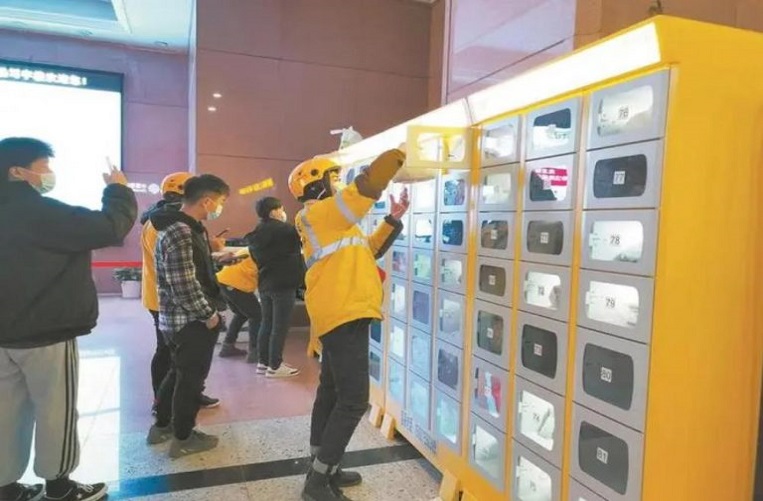
The problem: Lunch deliveries arrive in a concentrated rush. Lobbies fill with riders, front-desk staff are pulled into handling meals, and employees waste part of their break looking for the right order.
How a locker helps: A bank of lockers near the building entrance gives riders a clear place to drop meals and employees a quick way to collect them. Riders no longer need to enter the building or wait for someone to receive the order, which keeps lobbies clear and security simpler. Reception teams are freed from acting as an informal delivery counter.
Why it matters to property managers: Lobby order and tenant satisfaction are part of the service you provide. A tidy, predictable pickup process is a visible improvement for everyone who uses the building.
2. Hospitals
The problem: Hospitals need meal delivery for medical staff, patients and visiting families, but they also have strict expectations around hygiene and contact. Unstructured handovers in corridors and entrances are inefficient and create unnecessary interaction.
How a locker helps: Individual compartments keep meals separated, while heating and UV sterilization support food quality and hygiene. Contact-free collection reduces direct handover between riders and recipients. Staff on shift can collect meals quickly rather than leaving their posts for long periods.
Why it matters to administrators: Predictable, traceable pickup reduces disruption in sensitive areas and gives the hospital a record of deposits and collections.
3. Schools and universities
The problem: Students have short breaks between classes. Meal deliveries to campus gates or dormitories can cause crowding, confusion about who collects what, and lost orders.
How a locker helps: Multiple verification methods, including pickup code, phone number and facial recognition, let students collect meals quickly. A standardized pickup point reduces crowding at gates and keeps delivery traffic away from teaching areas. Administrators gain visibility through records of who deposited and who collected each order.
Why it matters to campus operators: A clear delivery process supports campus safety and order while giving students a convenient service.
4. Corporate cafeterias and industrial parks
The problem: Large workforces have limited meal times. Serving counters create queues, and long waits reduce the time employees have to eat or rest.
How a locker helps: Employees can pre-order through an app and collect meals using a face or code scan, which shifts the pressure from a single serving counter to a distributed pickup point. Meals stored in heated compartments stay at a suitable temperature until collection, which helps in environments where employees arrive at different times.
Why it matters to cafeteria operators: Shorter queues mean more people served in the same window without adding staff or counter space.
5. Shopping malls and transport hubs
The problem: Malls, stations and airports are busy public spaces where visitors and commuters want to collect meals quickly. Without a designated point, riders gather in walkways and entrances, which affects the order and appearance of the space.
How a locker helps: A standardized meal reception point gives riders and customers a defined place to complete handovers. This improves the order of public spaces and gives commuters a fast, predictable way to collect an order on the move.
Why it matters to mall and hub operators: Keeping delivery traffic organized protects the visitor experience and helps manage foot traffic.
What these venues have in common
Despite their differences, all five environments need the same three things:
Speed during peak hours. Multiple verification methods and self-service access reduce queues.
Food safety. Heating, individual compartments and UV sterilization protect meals while they wait.
Traceability. Automatic records of the depositor, pickup person and time stamp make management and dispute handling simpler.
Planning a deployment
When we help venue operators plan, we usually start with a few questions:
How many orders do you expect during your busiest hour?
Who will use the lockers: employees, students, patients, general visitors?
Which delivery platforms or ordering apps do you need to connect?
Is the unit going into an entrance, a lobby or a dedicated pickup area?
What screen size and housing material suit the environment?
The MINNO locker is available with Android touchscreens from 7 to 32 inches and with galvanized steel or 304 stainless steel housing, and its lock control system supports multi-board cascade for expansion.
Frequently asked questions
Is the locker suitable for public spaces with many different users?Yes. Pickup can be done by code, phone number or facial recognition, so it does not depend on one specific app or user group.
Does it keep food warm?Each compartment has a food-grade stainless steel heating board holding a constant 45°–60°C, controlled by a temperature controller.
Is there a record of who collected an order?Yes. The system automatically logs the depositor, the pickup person and the time stamp.
Can we add more compartments later?The lock control board supports multi-board cascade, which allows the system to be expanded.
Talk to our team
Tell us about your venue and expected order volume, and we will propose a layout and configuration.
Email: sales@buysmartlocker.comWhatsApp / Phone: +86 132 1355 7186
Our Contact
Minno Furtniture
Customize smart storage lockers,parcel delivery lockers, key management cabinet,Vending machines,Office/School and home furniture.
-
Call For Inquiry
-
Send Us Email
sales@buysmartlocker.com
Need Help For Project!
We are ready to help your next projects, let’s work together
 WhatsApp
 sales@buysmartlocker.com
 +8613213557186