

News
04
Nov
Mobile Tool Cabinet: What "Rolling" Actually Changes in a Workshop
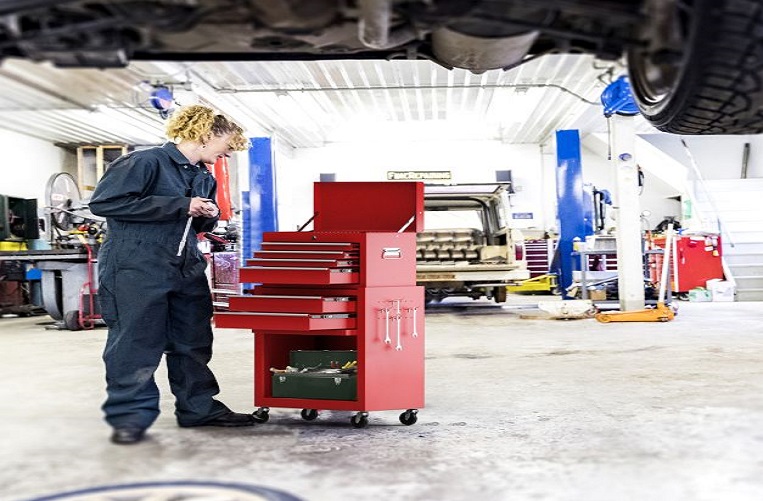
A mobile tool cabinet is not a workbench with wheels bolted on. It is a different way of arranging work: instead of the technician walking to the tool wall, the tools travel to the job. That single change decides the drawer layout, the caster specification, the lock design, and — most often overlooked — the floor the cabinet rolls on.
The MINNO Mechanic Professional Cabinet (model MN-T087) is a 7-drawer rolling cabinet: 1,010 mm high, 765 mm wide, 460 mm deep, cold-rolled steel at 0.8–1.5 mm, epoxy powder coated, on four swivel casters with two brakes, secured by a single central key lock.
Whether that is the right cabinet depends on four questions: what rolls it, what holds it, what secures it, and what it stands on. Each has an answer you can check before ordering.
What "Mobile" Changes
In a fixed tool store, drawers are organised for storage. In a rolling cabinet, drawers are organised for transport and access at the point of use. The differences are concrete:
Weight moves. A static cabinet's load sits on the floor. A mobile cabinet's load sits on four casters, and every time it moves, that load transfers through them onto whatever the floor is. A cabinet that is fine in a workshop with a sealed concrete slab is a problem in a garage with an expansion joint every three metres.
Height becomes a working decision. At 1,010 mm overall height, the top plate lands at roughly workbench height — which is the point of the integrated work surface. But it also means the bottom drawer is at floor level, and the top drawer is at chest height. Who uses which drawer changes with the cabinet's role: a rolling diagnostic cart wants frequently used tools at waist height; a rolling bench wants the top clear.
The lock has to survive movement. A central locking system that secures all drawers with one key is the right answer for a mobile cabinet, because the alternative — seven separate drawer locks — is seven keys to lose and seven locks to check before the cabinet moves. One key, one turn, all drawers locked: that is a travel-safe design.
The cabinet becomes a thing people borrow. A mobile cabinet with tools in it will be rolled to another bay. That is the feature. It is also the risk: without a lock discipline, the cabinet ends up somewhere else with half its tools. Plan for one cabinet per technician or per bay, not one cabinet per shop, unless the shop runs a sign-out system.
Specifications at a Glance
Three numbers the specification does not publish, and they matter for procurement:
Individual drawer dimensions. "7 drawers, mixed deep and shallow" does not tell you whether a 500 mm torque wrench fits flat or has to go diagonally.
Per-drawer load rating. No figure is given per drawer or for the cabinet in total.
Caster diameter and tread material. These decide whether the cabinet rolls over a workshop floor drain cover or gets stuck on it.
Ask for all three in writing before a purchase order. They are standard engineering data a manufacturer holds, and a supplier who cannot produce them is telling you something.
Seven Drawers, One Key: The Central Lock Decision
The cabinet uses a single key lock that secures all drawers simultaneously. In practice that design has four consequences worth knowing before purchase.
1. It is travel-safe, which is the whole point. A cabinet that will be rolled across a workshop — past a lift, through a doorway, onto a ramp — must not be able to spill its drawers in transit. A central lock does that in one movement. Seven individual locks do it only if the technician remembers all seven.
2. It makes shared use awkward in a specific way. If two technicians share a cabinet, they share a key, which means either duplicate keys or an unlocked cabinet. The alternative — one cabinet per technician, each with its own key — is cleaner and is how most professional shops actually operate.
3. Key control becomes the security model. With a central lock, the shop's tool security is only as good as the key register. That has a cheap, effective answer: a numbered key tag and a signature log at issue, so a lost key is a known event rather than a discovery. For high-value tooling, ask whether the lock can be keyed alike across a fleet (one key for all cabinets) or keyed differently (one key per technician). Both are standard options and the choice is operational, not technical.
4. It is a barrier, not a safe. A central key lock stops casual access and deters opportunism. It does not stop a determined thief with a pry bar. If the site stores high-value diagnostic equipment, the correct control is the room, not the drawer — a locked workshop or a cage, with the cabinet as the second layer.
Casters: The Specification That Decides Whether "Mobile" Works
Four swivel casters, two braked. That is the standard configuration and it is adequate for most workshops. What it does not tell you is whether the cabinet will actually roll where you need it.
Floor condition dominates. Sealed concrete, epoxy floor, and smooth tile are fine for any industrial caster. What fails: expansion joints, floor drains with raised covers, painted floors that have worn into ridges, workshop mats, and the lip of a roller door. If the cabinet has to cross any of those daily, caster diameter is the deciding variable — and it is not published. Ask.
Brakes are a safety item, not a convenience. Two braked casters out of four is standard and sufficient on a level floor. On a sloped floor — a garage with a drainage fall, a trailer, a ramp — two brakes are not enough, and the cabinet will creep. If the site has any slope, specify four brakes or a chock.
Gross weight is 70 kg. Spread across four casters that averages about 17.5 kg per caster before tools are added. Industrial casters are rated well above that, so the load is not the constraint; the constraint is the floor surface and the quality of the swivel bearings. Cheap casters on a 70 kg cabinet feel fine empty and become a two-person push when loaded.
Doorway width, not cabinet width. The cabinet is 765 mm wide, but a swivel caster cabinet needs diagonal clearance to turn. Plan 900 mm of clear opening for comfortable movement through a doorway, and check the route before delivery — a cabinet that cannot reach the bay is a cabinet that lives in the corridor.
The Top Plate as a Work Surface
The reinforced top plate spans the cabinet footprint, roughly 765 × 460 mm — about a third of a square metre, roughly the footprint of a large laptop and a tool tray side by side. It is a temporary work surface, and the word matters:
It suits assembly, inspection, laying out a part, holding a torque wrench and a manual.
It does not replace a bench vise. Clamping to a plate that sits on four casters transfers every lever force into the caster bearings and the cabinet's stability.
It must be kept clear if the cabinet is a rolling cart. A top plate loaded with parts is a cabinet that cannot be moved without unloading it first.
The practical rule: decide at purchase whether this is a rolling bench (top clear, cabinet parked) or a rolling cart (top used in transit, cabinet moves). The drawer layout should follow that decision — a rolling bench wants the heavy, rarely used items low and the top free; a cart wants the working set at waist height.
Steel at 0.8 to 1.5 mm: Where the Gauge Goes
The specification quotes a range rather than a single figure: 0.8 to 1.5 mm. That is normal for a customisable cabinet, and it is worth understanding where each end of the range typically sits, because gauge distribution is what separates a professional cabinet from a domestic one.
Thicker steel (toward 1.5 mm) belongs in the structural parts: the base frame, the caster mounting plates, the top plate, and the drawer fronts that take the pull.
Thinner steel (toward 0.8 mm) is normal for drawer sides, internal dividers, and back panels, where it carries no structural load.
What to check on receipt, in this order: caster mounting plates (thin plates tear at the bolt holes under a moving load), drawer runners (the slide mechanism, not the steel), and top plate deflection (press the centre — if it flexes noticeably under hand pressure, it will flex under a gearbox).
Epoxy powder coating is the right finish for a workshop: it resists oils, brake fluid, and most shop chemicals better than paint, and it does not chip into sharp edges the way sprayed enamel does. It is not chemical-proof — brake fluid left on a powder-coated surface will still damage it — so a wipe-down after fluid work is worth more than any finish upgrade.
ESD: When You Actually Need It
The cabinet offers ESD protection as an option. That is relevant to a narrower group than the marketing suggests:
You need it if the cabinet stores circuit boards, sensors, electronic control units, or anything with exposed semiconductors — automotive electronics diagnostics, aerospace, electronics manufacturing, laboratory instruments.
You do not need it if the cabinet stores hand tools, sockets, wrenches, power tools, or mechanical parts. A conductivity path to ground changes nothing for a box of spanners.
The distinction matters commercially because ESD cabinets cost more, and a shop that buys ESD "just in case" has paid for a feature that does nothing in its workflow. Conversely, a shop storing ECUs in a standard cabinet has a real failure mode — a static discharge through a control unit is an intermittent fault that is expensive to diagnose and impossible to prove.
If ESD is required, ask two questions: whether the casters are conductive (a grounded cabinet on insulating wheels is not grounded), and how the ground path is verified and maintained. Both are answerable, and both are routinely missed in procurement.
What the Spec Sheet Does Not Say
A specification table is a starting point, not a purchase decision. These are the questions this page leaves open, in priority order:
Drawer dimensions. Measure the longest tool you own — a torque wrench, a breaker bar, a slide hammer — and ask for the internal drawer dimensions in writing.
Load rating per drawer and total. A cabinet rated for hand tools and one rated for a gearbox on the top plate are different products.
Caster diameter, tread, and brake count. Ask for diameter in millimetres and whether four brakes are available.
Drawer runner type. Ball-bearing slides versus roller slides is the single biggest determinant of how the cabinet feels in year three.
Lock keying options. Keyed alike across a fleet, keyed differently per unit, or master-keyed.
Whether the liners are foam or rubber, and how thick. Foam shadowing is a layout tool; rubber is a non-slip mat. They are not interchangeable.
Assembly state on arrival. The spec says fully assembled and the carton is essentially cabinet-sized, so it should arrive built — confirm, because a 70 kg cabinet in pieces is a different delivery problem.
Lead time and minimum order for a custom RAL colour and a custom drawer split, both of which the manufacturer offers.
Mobile Cabinet, Fixed Workbench, or Tool Chest?
The range contains several tool storage formats, and the choice is about workflow, not quality.
The decision rule: if the technician walks to the tools more than twice an hour, buy mobile. If the tools never move, buy fixed and use the money on capacity. A mobile cabinet used as a static one is a cabinet with a worse floor contact and a higher price.
Frequently Asked Questions
What are the dimensions of this tool cabinet?
1,010 mm high, 765 mm wide, and 460 mm deep, which is about 39.8 × 30.1 × 18.1 inches. The top plate is 765 × 460 mm and is reinforced to work as a temporary surface. Gross weight is 70 kg, and the cabinet ships fully assembled in a carton of 76.3 × 46 × 101 cm.
How many drawers does it have?
Seven, in a mix of deep and shallow drawer heights, each with removable foam or rubber liners. Individual drawer dimensions are not published on the product page — ask for them in writing against your longest tool before ordering.
How much weight can each drawer hold?
No per-drawer or total load rating is published for this model. That is the single most important figure to obtain before purchase, because a cabinet specified for hand tools and one specified for heavy components are different products even when they look identical.
Does one key lock all the drawers?
Yes. A single central key lock secures all drawers at once, which is what makes the cabinet safe to roll across a workshop without drawers sliding open. Ask about keying options — keyed alike across several cabinets, or a different key per technician — if more than one unit will be in service.
Can it be used on a sloped floor?
Two of the four casters have brakes, which is adequate on a level floor. On a slope — a garage with a drainage fall, a trailer, a ramp — specify four braked casters or use chocks, or the cabinet will creep when loaded.
Do I need the ESD option?
Only if the cabinet stores circuit boards, sensors, ECUs, or other static-sensitive electronics. For hand tools, sockets, and mechanical parts it changes nothing. If you do need it, confirm that the casters are conductive and ask how the ground path is verified.
What colours and configurations are available?
Custom RAL colour, with customisation offered on size, drawer configuration, caster type, and locking mechanism. That means lead time and minimum order quantity are configuration-dependent — confirm both before specifying a non-standard RAL or drawer split.
Is it delivered assembled?
The specification states fully assembled, and the carton dimensions are effectively the cabinet's own footprint, which supports that. Confirm on the quotation, since a 70 kg cabinet arriving in parts is a very different handling problem.
Tools that come to the job. The MINNO Mechanic Professional Cabinet (MN-T087) is a 7-drawer rolling cabinet in 0.8–1.5 mm cold-rolled steel, 1,010 × 765 × 460 mm, with four swivel casters, a central key lock, and an ESD option — ISO 9001 and ISO 14001 certified, with custom RAL colour and drawer configuration. Send us your longest tool, your heaviest drawer load, and your floor condition, and we will confirm the drawer split, caster specification, and keying before you commit. The full tool cabinet range covers fixed, hanging, and workbench formats if mobility is not the requirement.
Our Contact
Minno Furtniture
Customize smart storage lockers,parcel delivery lockers, key management cabinet,Vending machines,Office/School and home furniture.
-
Call For Inquiry
-
Send Us Email
sales@buysmartlocker.com
Need Help For Project!
We are ready to help your next projects, let’s work together
 WhatsApp
 sales@buysmartlocker.com
 +8613213557186