

News
16
Jul
Smart Key Management Cabinets: The Future of Secure Key Control for Modern Businesses
Keys may be small, but the way they are managed has a significant impact on security, operational efficiency, and accountability.
Across industries such as property management, automotive dealerships, logistics, manufacturing, healthcare, hospitality, and government facilities, organizations still rely on hundreds—or even thousands—of physical keys every day. When those keys are managed manually, the risks quickly add up: lost keys, unauthorized access, delayed operations, and expensive lock replacements.
This is why smart key management systems have become an increasingly important part of modern access control. Rather than simply storing keys, these systems provide intelligent tracking, user authentication, audit trails, and centralized management that help businesses improve both security and efficiency. Industry guidance consistently highlights access control, accountability, and documented key policies as essential components of effective key management.
What Is a Smart Key Management Cabinet?
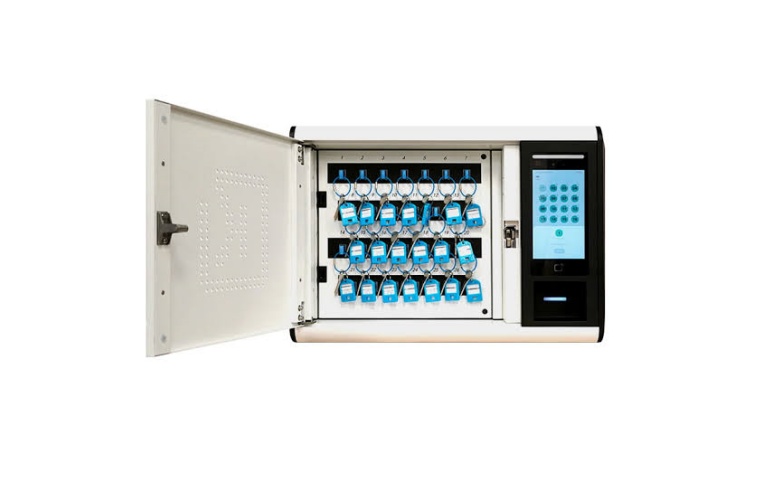
A smart key management cabinet is an electronic key storage system designed to control, monitor, and record every key transaction.
Unlike a traditional key cabinet that simply locks all keys behind a door, a digital key management system authenticates users before access is granted and automatically records who removed a key, when it was taken, and when it was returned. Modern systems may use PIN codes, RFID cards, biometrics, or mobile credentials for authentication.
For organizations responsible for multiple buildings, vehicles, equipment, or restricted areas, this creates a transparent chain of accountability that manual sign-out sheets cannot provide.
Why Traditional Key Management No Longer Meets Business Needs
Many organizations still rely on paper logs, pegboards, or locked drawers to manage keys.
While these methods appear simple, they create several operational challenges.
No Visibility
Without digital records, managers often have no immediate way of knowing:
Who currently has a key
When it was removed
How long it has been out
Whether it has been returned
Searching for missing keys wastes valuable time and often disrupts operations.
Increased Security Risks
A misplaced master key can become a serious security issue.
Replacing locks throughout an office building, hotel, hospital, or manufacturing facility can cost thousands of dollars—not including operational downtime. Poor key control also increases the risk of unauthorized access and liability.
Lack of Accountability
Manual sign-out sheets depend entirely on users remembering to complete them accurately.
In busy workplaces, records are frequently incomplete, inaccurate, or ignored altogether.
Difficult to Scale
Managing ten keys manually is relatively easy.
Managing several hundred keys across multiple departments, buildings, or vehicles is an entirely different challenge.
As organizations grow, manual processes become increasingly inefficient.
How Smart Key Cabinets Improve Security
The biggest advantage of a smart key cabinet is that it transforms key storage into a controlled access process.
Instead of relying on trust alone, businesses gain measurable security through technology.
User Authentication
Every authorized user has a unique identity.
Access may be verified through:
PIN codes
RFID employee cards
Fingerprint recognition
Facial recognition
Mobile credentials
Multi-factor authentication
This prevents anonymous access and reduces the possibility of unauthorized key removal.
Complete Audit Trails
Every transaction is automatically recorded.
Managers can review:
User identity
Date and time
Key issued
Return time
Duration of checkout
These digital audit logs improve compliance and simplify investigations when incidents occur.
Real-Time Monitoring
Modern electronic key management systems provide real-time visibility into key status.
Instead of searching throughout a building, administrators immediately know:
Which keys are available
Which keys are in use
Which user currently holds each key
This improves operational efficiency while reducing administrative workload.
Permission-Based Access
Not every employee needs access to every key.
Smart systems allow organizations to assign permissions based on:
Department
Job role
Working hours
Security level
Temporary authorization
This follows the principle of least privilege and strengthens overall physical security.
Industries That Benefit from Smart Key Management
Although often associated with security companies, intelligent key management systems are now used across many sectors.
Property Management
Residential communities, commercial office buildings, and mixed-use developments often manage hundreds of keys.
A wall-mounted smart key cabinet helps property managers track maintenance keys, master keys, vacant units, utility rooms, and contractor access.
Automotive Dealerships
Vehicle keys represent valuable assets.
Digital key management reduces misplaced keys, speeds up vehicle handovers, and improves accountability among sales teams and service departments.
Hotels
Hotels manage guest room master keys, housekeeping keys, engineering access, and emergency keys.
Smart cabinets simplify shift changes while maintaining strict access records.
Healthcare Facilities
Hospitals require controlled access to:
Pharmacy rooms
Medical equipment
Restricted departments
Vehicle fleets
Maintenance rooms
Electronic tracking improves both compliance and operational efficiency.
Manufacturing
Factories commonly manage:
Forklift keys
Machine room keys
Warehouse access
Vehicle fleets
Maintenance equipment
Automated key control minimizes production delays caused by misplaced keys.
Government and Public Institutions
Government facilities frequently require detailed audit records for security compliance.
Smart key cabinets provide traceable access histories that support internal control policies.
Integration with Modern Access Control Systems
Today's smart key management solutions increasingly integrate with broader security ecosystems.
Depending on system architecture, they can work alongside:
Access control systems
Visitor management software
Employee ID platforms
Building management systems
Security monitoring software
Fleet management platforms
This creates a unified security environment where physical assets and user permissions are managed more efficiently.
Choosing the Right Smart Key Management System
Not every organization requires the same solution.
When evaluating a commercial key management cabinet, businesses should consider:
Capacity
How many keys will the system manage today—and in the future?
Scalable systems reduce future replacement costs.
Authentication Methods
Choose authentication options that align with existing corporate security policies.
Software Management
Cloud-based platforms often provide:
Remote monitoring
Centralized administration
Multi-site management
Automatic reporting
User management
Audit and Reporting
Comprehensive reporting is particularly valuable for organizations operating under regulatory or internal compliance requirements.
Expandability
As organizations grow, additional cabinets or locations should integrate into the same management platform whenever possible.
Best Practices for Effective Key Control
Technology alone cannot solve every security challenge.
Organizations should also establish a formal key management policy that defines:
Who may request keys
Approval procedures
Return requirements
Lost key reporting
Periodic audits
Emergency access procedures
Regular inventory checks, clear responsibilities, and documented processes significantly improve long-term security and accountability.
The Future of Physical Key Management
As businesses continue adopting digital transformation strategies, physical security is evolving alongside IT security.
While digital credentials and smart locks continue to expand, physical keys remain essential for many facilities, vehicles, equipment rooms, and critical infrastructure.
Rather than replacing physical keys entirely, organizations are increasingly modernizing how those keys are managed.
A smart key management cabinet bridges the gap between traditional physical security and intelligent access management by combining secure storage, automated tracking, and real-time visibility into one centralized solution.
For organizations seeking stronger security, improved operational efficiency, and better compliance, electronic key management has become a practical investment rather than simply a convenience.
Frequently Asked Questions (FAQ)
What is a smart key management cabinet?
A smart key management cabinet is an electronic system that securely stores physical keys while automatically recording user access, key removal, and return activity.
How is a smart key cabinet different from a traditional key cabinet?
Traditional key cabinets only secure keys behind a mechanical lock. Smart key cabinets add user authentication, digital audit logs, permission management, and real-time tracking.
Which industries use electronic key management systems?
They are widely used in property management, automotive dealerships, hospitals, hotels, logistics companies, manufacturing plants, government facilities, schools, and corporate offices.
Can smart key cabinets improve compliance?
Yes. Automated audit trails and permission-based access help organizations meet internal security policies and many industry compliance requirements.
What should businesses consider before purchasing a smart key management system?
Key factors include cabinet capacity, authentication methods, software capabilities, reporting functions, scalability, integration options, and after-sales support.
Contact Us
📞 Phone/WhatsApp: +86 132 1355 7186
📧 Email: sales@buysmartlocker.co
Our Contact
Minno Furtniture
Customize smart storage lockers,parcel delivery lockers, key management cabinet,Vending machines,Office/School and home furniture.
-
Call For Inquiry
-
Send Us Email
sales@buysmartlocker.com
Need Help For Project!
We are ready to help your next projects, let’s work together
 WhatsApp
 sales@buysmartlocker.com
 +8613213557186